Bridges in Sadiya

This is the last of my columns on Northeast India for First City magazine, a double feature combining August and September’s columns (which does make it a bit long, but I hope worthwhile). Comments, etc. welcomed.

————————–

Bridges in Sadiya

You’re So Handsome

The government official in the small town in Arunachal Pradesh was all business on our first meeting. We presented our reference and he happily shared a number of valuable suggestions regarding travelling in the region. A few evenings later, when we went to say goodbye, he was in his office with a friend.

“Come in, come in”, he beckoned. He ordered his assistant to bring us tea (which he spiked with rum) and genially inquired about our travels. Then, out of the blue, he said “You boys are sooo handsome. You should get married soon.” Since we’d been backpacking for the last two weeks, we were in fact dirty, unshaven and malodorous. We soon realized he was hitting on my travel buddy, who started to feel uncomfortable every time the bureaucrat crooned at him (“You’re so handsome”, like a stuck record) or brushed past with a hand pressing on shoulder. The long arm of the law.

It was past 8 p.m. and he’d sent a couple of drinks too many down the hatch. He complained about his salary, how much more his friends in private business were making, and how desperate he was to immigrate to America. This middle-ranking government official swore, “I will sweep the streets, I will wash people’s clothes, as long as I can get to America.” He also confided that his favourite city was Bangkok, where he’d been a few times on government work. “In Bangkok, you should always carry an extra condom because, you see, you pay by the hour. So if you forego the bath and the massage, you will have time to do it more than once.”

In the end, he invited us to go on a ‘night about the town’ with him, accompanying the relatively nondescript statement with a theatrically obscene gesture that made clear what such a night would entail. Seeing our terrible attempts at a poker face, he smiled sheepishly, “I’m happily married of course but, you know, a man needs new girls often. It’s a basic need, after all. Why don’t you boys come? We’ll find you some nice girls for the night…” In the midst of our stunned silence, his far more sober friend said something sharply in the local language. They argued for a while, the friend being insistent, and then he turned back and said, “Ok, maybe you better not come.” We fled.

Itafort on Sunday

The Itafort in Itanagar is ostensibly a tourist attraction but even auto drivers barely know how to get there. Today, this 15th century fort is so poorly maintained that all that remains are a handful of scattered forlorn piles of bricks.

Entering the premises late on a Sunday afternoon, we came across the once famous ‘South Gate’ of the fort. A group of primly dressed youth (of both sexes) sat on top of the gate practising Christmas Carols – calmly and naturally with no trace either of shyness or ceremony, like it was the most natural thing in the world to be singing hymns in public. A few yards behind the gate, a gang of teenage boys lounged on the grass drinking beer. In stark contrast to the formally dressed carollers, these were punks: spiky gelled hair, ear-rings and tattoos, black T-shirts with pictures of heavy metal bands or hip-hop icons, and boxer-revealing baggy jeans. They laughed and play-acted while they drank but kept their camaraderie to themselves. Just a few feet away, yet in an entirely separate group, a bunch of teenage girls sat together on a bench facing away from the punks. They were in the modern youth uniform of low-waisted jeans and white tank-tops under pastel-coloured jackets. They chatted and giggled in their own private world while admiring the impressive view of Itanagar town surrounded by lush rolling hills. Further down, a young couple relaxed against some rocks. As we walked past, the girl stared at us with unabashed curiosity. She was wearing an Army camouflage spaghetti-top that stopped well above her navel and knee-length Bermuda shorts. With her hair curling randomly around her face, bare shoulders and legs, a sultry come-on look in her eyes, and cigarette between her fingers, she was in every way the quintessential rebel.

Of such distinct groupings then was Itafort on Sunday. We sat down to look at the view, conscious most of all of being woefully out of place as two Indian men amongst several Arunachali teenagers. But it was an idyllic afternoon: the trees were in bloom, the birds in song, and eventually the sun descended gently down on our sense of surrealism.

Bridges in Sadiya

“So who are your favourite actor and actress?” D, my travel companion asked. The boy didn’t hesitate for a second. “Aishwarya Rai and Aftab Shivadasani”.

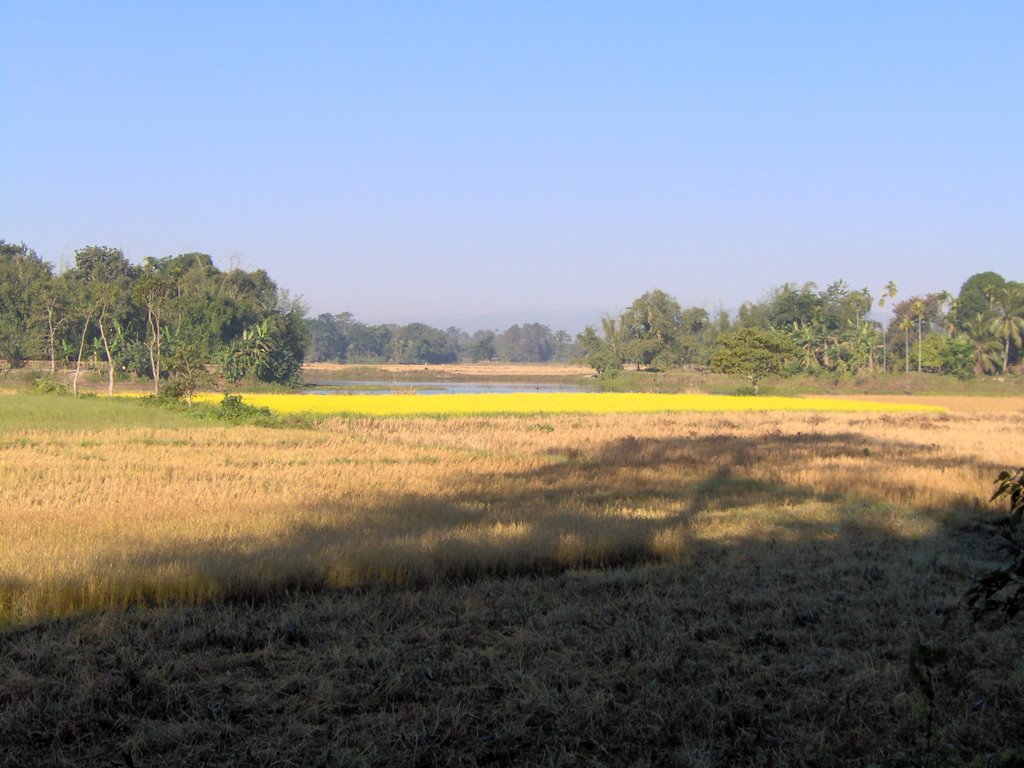
We were in a Mising (pronounced ‘Mishing’) village in the Sadiya region of northeast Assam. Braced against the Arunachal Pradesh border, Sadiya is a lovely land where roads meander windingly through endless paddy and mustard fields, interspersed every now and then with groves of banana or papaya or gooseberry surrounding stilt-raised Mising villages. We’d been sitting outside, one evening after dinner, enjoying the starry night sky with that mingled sense of wonder and loss that city dwellers often experience when they find themselves in places where they can see the stars. A couple of Mising teenagers, a boy and a girl, walked up to us and began chatting. Eventually, the conversation veered to Bollywood. At first, I was mildly surprised to see how much Bollywood had penetrated this remote corner of the country but thinking that if East Africans can be crazy about Aamir Khan (I’ve met a few), then tribal Mising knowing their Bollywood shouldn’t come as a shock.

“What about you”, I asked the girl, whose name was Tarang. She appeared to ponder the question quite seriously and then, with a thoughtful look said, “I like Hrithik Roshan best.”

“Hey, you know my name is Roshan too”, I said, God knows why. She looked up at me with the international expression for ‘Whatever, Dufus’.

“What about Shah Rukh Khan?” D, a devout King Khan disciple, sounded surprised that her hero hadn’t been mentioned. Hands on hips, and full of contempt for the Dilliwallas in her midst, Tarang answers “I think he is a bit silly and over-romantic.”

D subsided, as I had done moments earlier, both of us now feeling firmly put in our place. And I thought with amusement that the most sensible thing I’ve ever heard said about Shah Rukh Khan came from a tribal teenager, unaffected by the histrionic charm that appears to make sophisticated urban women weak in the knees.

Both Mising teenagers were participants in a youth development training program run by a local NGO, which had realized that the Mising tribe was the only major ethnic group in Assam yet to take to militancy. The Misings are a primarily river-basin tribe found along the Brahmaputra and its tributaries in Assam and Arunachal Pradesh. Unfortunately, they are also perhaps the most impoverished of Assam’s many tribes, which makes their reluctance to take up arms even more remarkable. Yet, they were just as unhappy with the State as the other tribes were, but received even less attention since they were still non-violent. Gradually, inevitably, several frustrated Mising youth had begun to consider forming their own militia.

Inspired by the Misings’ reluctance to violence, the NGO developed a training program for young Misings who had dropped out of the formal education system. Rather than ignoring these youth, as the formal government system tends to do, the three-year ‘Rising Stars’ program equips them to become dynamic leaders who will take their communities forward. The overall goal is to harness the local wisdom and creative potential of these youth for community development, and in doing so provide an incentive against resorting to militancy.

The ‘Rising Stars’ program is the brainchild of a Salesian priest, whom I shall call Fr. Kat. Like so many other priests and nuns in this region, Fr. Kat is a Malyali who made the astonishing decision, at the age of fifteen, to leave his home and journey to Northeast India to serve God by serving people. He went there knowing he would stay for life. After thirty-five years in the Northeast, he is now more Assamese than Malyali (although the Malyali accent still comes through).

He is also one of a handful of priests who are going well beyond the call of duty in working for peace in this troubled region. I’ve always been uneasy with missionary activity, and always strongly opposed to evangelization. But several priests I met all over the Northeast helped me see that a priest can carry out his duty to serve without necessarily converting others to his faith, and indeed without even feeling a need or obligation to do so. When Fr. Kat decided to begin his program, he was told he couldn’t do this from within his Order. He promptly quit, and though he still maintains close ties with his former colleagues, he now operates independently.

Today, everyone who cares is shouting themselves hoarse that the Northeast needs serious attention from India’s policymakers and that such a large region cannot be allowed to fall behind as the rest of the country marches on. But how will an essentially tribal culture react to an onslaught of consumerism? What will be the cultural implications of progress and modernity? Fr. Kat replied, “So what if the culture changes. What is the value of culture if, after all, it keeps a people behind? Of course, progress must happen in moderation and with due respect to traditional values but, yes, some values may and perhaps should change.”

So what then is the solution to the Northeast’s political problems: should those who want it be allowed independence or must they stay within India? Fr. Kat, an outsider who has made this region home over the last four decades, seemed like the ideal person to ask this incredibly thorny question. Given his life’s work and passion for the people here, if anyone’s opinion was worth noting, it would be his. He rubbed his chin thoughtfully and leaned back against his chair. “I don’t know. I’ve thought so much about this but I still can’t give a definitive answer. I just don’t know.”

Crossing the border from Sadiya into Arunachal Pradesh is a contrast so stark it makes you laugh. Prone to being ravaged by the flooding of the Brahmaputra, roads in Sadiya are little more than a concept, one which the Assamese government seems to have given up on. However, Arunachal Pradesh, though economically much less developed than Assam, has great roads due to its status as a sensitive border zone: its roads are maintained by the Indian Army. So you go bump bump bump across Sadiya at 15km/hr, step across the border and speed along towards the Himalayas at 70 km/hr.

Across this contrasting border, en route to the Arunachal town of Roing, flows the Deopani River, one of the tributaries of the mighty Brahmaputra. In the dry season, it’s little more than a stream, gurgling along through about a tenth of its normal riverbed. But in the wet season, this tiny stream becomes engorged, a raging torrent carrying along huge rocks with force enough to destroy concrete bridges. Driving through the riverbed in our jeep, I saw the remains of a concrete bridge that looked like it had been broken off like a piece of chocolate to sate the craving river. Every year the government makes new bridges and every year the river pulls them down with glee.

In many ways, attempting to solve the complex and intricate problems of the Northeast is like attempting to bridge that enraged river. The forces at work in the region seem to delight in foiling the best laid plans, as the river tosses aside the sturdiest bridges. Yet, creative initiatives like the ‘Rising Stars’ program provide hope, gradually taking hold in unlikely ways and places. And forging bridges that last.

Posted in Travels in Northeast India | Leave a comment

Sixth Course, Session 2: Ellen Johnson Sirleaf

What do you do if you’re over 65 years old, a mother of four and a grandmother of six, the first woman ever to be elected President in all of Africa, and the first black woman ever to be elected President anywhere? Why, you roll up your sleeves and get down to governing, of course. At least that’s what Ellen Johnson-Sirleaf, Liberia’s new President (and a K-School alum) has been doing, as she shared with us in a lecture last Monday.

And if your country has just come out of a destructive civil war, then you celebrate something as basic as turning on the electricity again.

Apart from that comment, her speech itself was dry, as perhaps any speech dealing with governance will be, and she didn’t attempt any oratorical theatrics. (I’ll admit I dozed off a couple of times.) But it was in the Q&A session that the leader inside her came to the fore, answering some tricky questions with poise, wit and charm; artfully dodging some, deftly deflecting others, but in the process exhibiting the wisdom and charm that got her to where she is, after agonizing decades of working under terrible predecessors.

When someone asked her why she hadn’t mentioned Charles Taylor in her speech, she looked directly at him and said, with a touch of genius as far as I’m concerned: “You know, that was purposeful. We’re trying to forget it happened.” And when one of my seniors, a woman from Nigeria, asked her what advice she had for a woman who wanted to be a President in Africa, she raised her fist in the air and said “Go for it! The glass ceiling has been broken, the gate is open.”

Two speeches at the Forum from world leaders – incidentally, Johnson-Sirleaf’s next destination was the UN General assembly the following day – and I’m already learning a lesson in leadership: you need to be able to talk a lot and make people laugh without actually saying very much. Hmmm.

Posted in Harvard Sixth Course | Leave a comment

Sixth Course, Session 1: Mohammed Khatami

One of the things Harvard is most famous for – largely through it’s own bragging – is the so-called “sixth course”, in which the caliber and/or celebrity status of the people who come here to give lectures and participate in panels is generally higher than other universities.

On my first weekend here, The Kennedy School hosted this gentleman.


It was a free talk, but tickets were only available through a lottery (first time in my life I ever won one). As I got there and slowly made my way past the squadrons of banner-waving protestors and then through the various levels of security into the school’s Forum, joining 800 other people packed like sardines into a smallish arena being patrolled by U.S. State Department Police, Boston Police, Cambridge Police, and other assorted plainclothes bodymen, I got the message loud and clear: “Sixth Course? You better believe it, brother!”

The talk was fairly decent and you can read about it here and here. Khatami used diplomatic language and didn’t name anybody – not even Osama bin Laden – but he didn’t hold his punches either. Not inspirational nor full of energy but at least engaging.

The most impressive thing about these talks at the Kennedy School is that anyone is allowed to ask the speaker a question, no matter how high profile the speaker or how ‘lowly’ the audience member. Still, several of the questions asked were extremely disappointing at best and offensive at worst. One kid actually strutted up to the mike and asked: “You said that Zionists are inherently violent. As a college student and a supporter of Israel, would you say that I am any more violent that the average college student?”

Idiot. Like any half-way decent public figure from the East, Khatami answered in indirect ways while making it clear he wasn’t dignifying the question. The student walked away shaking his head and muttering, “He didn’t answer me.” Similarly, most of the other questions asked by undergraduates – largely the quickest to the microphones scattered around the Forum – were in this vein: strident, immature, rude. Khatami danced around these questions with dignity but other people around me grew frustrated at his lack of directness.

As I return to America, this reminded me again of how this level of frankness and antagonistic debating style is such a quintessential part of the American way but so alien to other countries and cultures. I’m a fan of this characteristic of Americanism but was annoyed that the Americans around me – in the nation’s most elite of educational institutions – don’t realize how rare this quality is in most other parts of the world, particularly the East.

Which all added up to a terribly lost opportunity to ask an insider any actually challenging questions about current policies and potential ways forward from the current US-Iran impasse.

Further reading (since I’m now back in school!): The Harvard College Dems Live Blog of the event

Posted in Harvard Sixth Course | Leave a comment

Tawang

July’s column (and pictures, also mine) for First City magazine. Comments welcome.

—————

Tawang

Say it with me; let the name roll gently of your tongue: Tawang. The moment I first heard that name, I knew I would go there one day. For Tawang is one of that collection of places – along with Zanzibar, Mandalay, Barbados, Mozambique – where so much of the exotic is conveyed in the sound of the name alone. Tawang is also not easy to get to; it requires more than fifteen bone-jarring hours of mountain driving from Tezpur on the Assam-Arunachal Pradesh border. But inaccessibility adds mystique, as every traveller will tell you, and the physical mystique of a hill-top settlement near the Indo-Tibet border surrounded by jagged snow-sprinkled peaks playing hide-and-seek with the clouds all add up to an irresistible allure.

So it sounds good, but what does it mean? Once upon a time, the story goes, a monk called Merak Lama had a horse than frequently vanished on him, only to turn up in the same spot every time. The Lama took this as an auspicious sign, named the spot Tawang (Ta = horse, wang = blessing; ‘blessed by a horse’) and decided to build a monastery there.

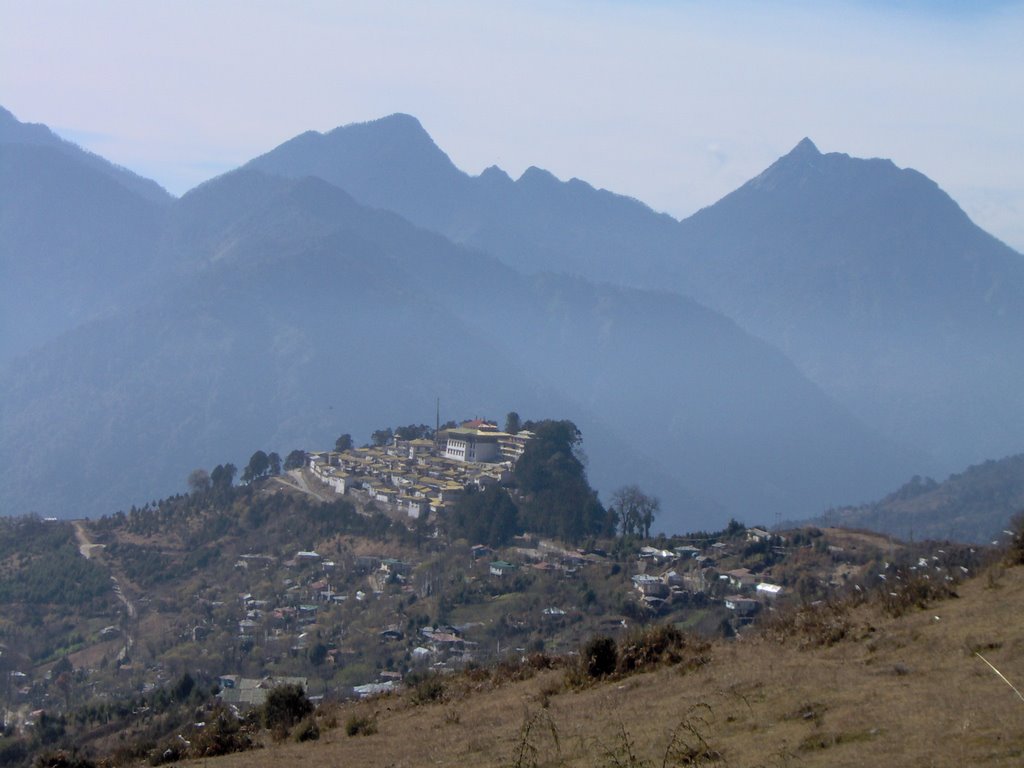
And what a monastery. Completed in 1580, and currently hosting over 320 monks, the Ganden Namghyal Lhatse Gompa is the largest monastery in India and apparently the second largest in all of Asia. It may also compete with Ladakh’s Lamuyuru Gompa for the nation’s most dramatically located monastery, especially when the setting sun paints it a striking orange in its valley cradle under the darkening spikes of the surrounding peaks.


Given the gompa’s reputation as a major centre for Buddhist heritage and study, it can be incongruous to walk up the road leading to the prayer hall and come across friendly novitiate monks sunning themselves whilst playing Tetris on a Nintendo Gameboy. Walk further, into the Buddhist Studies building, and you can see classrooms of shaven-headed maroon-robed young monks-to-be receiving instruction in the tenets of Buddhism. And while these eight-year-olds may become sagacious monks one day, now they are like eight-year-old boys anywhere: pushing, pulling, teasing and tripping each other with grubby hands, runny noses and unabashed curiosity towards these strange Indians on their doorstep.

For a monastery of this repute, its prayer hall is surprisingly small. The far end of the darkened rectangular room hosts the requisite large Buddha statue with a framed photograph of the Dalai Lama resting on an altar beneath it. Stretching out from the statue to the mural covered entrance are rows of simple cotton mattresses for prayer or meditation. The accompanying museum has an impressive collection of gilded Boddhisattva statues, massive elephant tusks, and jewellery and other artefacts belonging to the family of Tawang’s most famous son: Tsangyang Gyatso, the sixth Dalai Lama, born in the suburb (if you can call it that) of Urguelling in1683.

The gompa also presents a fine view of the small town of Tawang, with its white houses, grazing fields and winding roads spread out across a series of rolling hills and high valleys in the Upper Kameng region of western Arunachal Pradesh. Known as Monyul by the indigenous Monpa tribe, the town itself is somewhat ramshackle, seemingly existing around and for the monastery and also as a pit-stop en route to the Indo-Tibet border. So what happens in a one-horse town – the clichéd phrase worth using because of its pun value here in ‘Tawang’ – when it’s usually freezing cold, pitch dark from 5:30 p.m., and there’s no nightlife or TV? Well, you could make a list like this:

Top 5 Things to Do in Tawang After Sunset
1. Try to stay up until 10 p.m.
2. Eat chowmein and Kit Kat for every meal.
3. Have a cup of tea every half hour
4. Take on a hostile populace in an unceasing battle to break Rs. 500 notes
5. Shop for rum and a wool hat at 7 p.m., and consider that an exciting night on the town

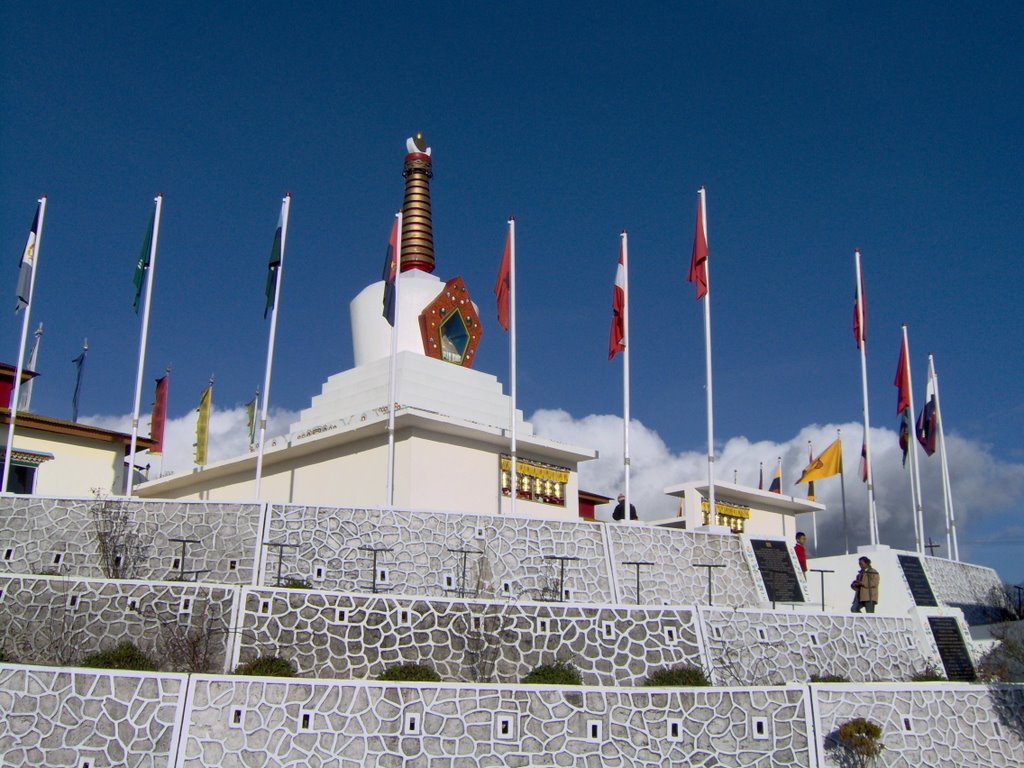
Being so close to such a sensitive international border – Tawang was one of the points through which the Chinese army invaded in 1962 – the Indian Army is ubiquitous here. Apart from the bored soldiers who are always insatiably curious about casual visitors, the stand-out testament to the military importance of Tawang is its War Memorial, unusual, as far as war memorials go, in that it is a stupa, complete with Buddhist murals and prayer wheels. From the ground below, only the twenty-five fluttering flags around the stupa – one for each of the regiments that fought in Tawang – distinguishes it from other stupas. You have to climb all the way up to the memorial to see that it commemorates the 2420 soldiers that fell before the Chinese forces in 1962. The centrepiece of the monument is the bust of Subedar Joginder Singh who is supposed to have held off two waves of Chinese soldiers on November 23rd before gallantly charging them with his bayonet once he saw that all hope was lost.


The Monpas of Tawang appear to have made peace with the ceaseless presence of soldiers and guns but every now and then a slogan painted on the wall of someone’s house indicates more complex emotions flowing beneath Tawang’s placid surface. My personal favourite, spray painted in black capital letters across the front side of a cottage, was this one: EDUCATION IS A BETTER SAFEGUARD OF LIBERTY THAN A STANDING ARMY.


The region of Tawang is also justifiably famous for the 108 high altitude lakes that nestle in its hills and valleys. Driving through the stunning countryside to visit some of these lakes is one of the highlights of any trip to Northeast India. Apart from the lakes, one of the most interesting (though easy to miss) spots is a pair of shrines on either side of the road by Grepthang Tso (Tso means ‘lake’ in Tibetan). One shrine contains a black Trishul resting serenely against an icy Shivaling in a tiny room with open windows overlooking a beautiful valley and, in the other, a creaky wooden door swings open to reveal a gorgeous fresco of Guru Nanak painted with ochre onto a large rock. Both shrines have an air of timelessness about them. Further down the road, a forlorn word has been painted onto several large rocks: Jassi; whether by an ardent fan of the soap opera or a pining soldier for a lover is anybody’s guess.

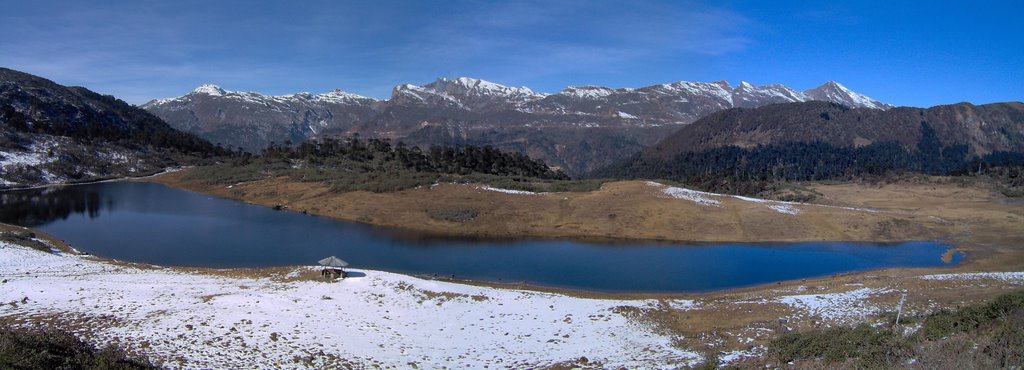
But it’s the lakes that you come here for, so that’s where we shall now go. The Pankang Teng Lake (known as PT Tso) is a fabulous introduction to the lake country but the highlight of the region, past PT Tso and Grepthang Tso and through the imposing archway of the “Ball of Fire Parvat Ghatak Academy” (at over 4000 feet, the highest artillery range in the country), is Sangetsar Tso. Popularly known as Madhuri Lake, after the filmstar Madhuri Dixit who pranced along its banks during the movie Koyla, the glacier-fed lake is slightly odd in that it contains a large number of bare tree stumps in the middle, remnants of a forest that was strangled to death when a change in the course of the glacial run-off created the lake. Although the stumps give the lake a somewhat decapitated look, they also add character to the astonishingly beautiful but also pretty much indescribable grandeur of this and all the other lakes of Tawang.


On the way from Tawang to Sangetsar Tso, you pass an Army checkpoint at 14655 feet near which is a signboard bearing the announcement “Celestial Paradise Begins Here.” About half an hour of monotonously spectacular scenery (jagged snow-sprinked mountains, virgin forests, deep blue lakes, grazing yaks, etc.) later, you reach Sangetsar Tso. But only as you’re leaving do you notice the hill. The lake is situated at the base of a massive barren black hill, with a sheer vertical face that tapers into a large solitary upright finger. It’s not hard to visualize this celestial watchman keeping vigil over the sublime water with one finger raised to the world as if to say, “This is indeed a celestial paradise, a playground of the Gods. Watch your step.”

Posted in Travels in Northeast India | Leave a comment

Consuming Kohima (Part 2): Chewing at Night

This month’s post for First City magazine. Comments welcome.

—————————
Consuming Kohima (Part II): Chewing at Night

Author’s note: It’s been my explicit intention in these columns not to delve into the conflicts that plague Northeast India, since I believe it is time that other aspects of the Northeast receive attention. However, with this particular column, I am breaking my rule. And I do so only to illustrate not just how thorny these issues are, but also how some people are creatively trying to make things better. Since these are sensitive topics, I must disclaim that I do not endorse the views expressed here, but am only trying to present what I heard as accurately as possible.

You cannot escape the insurgency in Nagaland. Its shadow hangs over every town, shrouds every village, and eavesdrops every conversation between a Naga and an Indian that takes place in Nagaland. It’s beyond the scope of this column to analyse both sides of this complex conflict, but for those who came in late, two key facts about the conflict are that it revolves around a movement for Nagaland to be separate from India and that it is the oldest running separatism movement in the country. Furthermore, the Naga separatists have trained and financed every other separatist movement in Northeast India, which is why many people – inside and outside Nagaland – believe that solving the Nagaland problem could be the most effective way of bringing peace to all of the Northeast.

Not that any of this was on my mind when, at my friend Y’s house for dinner, he offered me a bite of the hottest chilli in the world. “Most people think the hottest chillis come from Mexico”, Y said, “but the hottest of them all grows here in Nagaland.”

He held out the chilli to me. It was orange in colour; a bright smooth orange that belied the reputation it had just received. “No thanks,” I shook my head. “I’m not into masochism.”

“Ok…well, at least smell it.” Y broke off a piece of the chilli and held it out again. I moved in to smell it but still had a good six inches to go when I found myself recoiling in horror. Even at that range, the aroma of the chilli had scorched my nostrils. Y laughed at my discomfort. “It’s hot stuff, no?”, he said and nonchalantly popped that broken-off piece of chilli into his mouth. I shuddered to think what it would be like to chew on it.

After dinner, while the women were watching TV (the soap Jassi, no less), Y took me into the kitchen and we sat down on little stools facing the heater. It was late November and hill-top Kohima was already bracingly cold. Y’s father, Q, soon joined us. Although Prohibition is the law in Nagaland, most people have a stash of alcohol in their houses, either country liquor or regular brands smuggled in from Assam. As we sipped our beers and warmed our hands and feet, the conversation moved inevitably to the conflict. And, with a couple of beers in him, Q’s tongue started to wag.

“No one will ever say it out loud”, he began, “but 90% of Nagas don’t want sovereignty from India. Do you know why?”

I shook my head. This was certainly not the impression I’d gained in my time so far in Nagaland.

“Because, unlike Assam, Nagaland doesn’t have the natural resources to sustain itself. We import everything! Let them put a trade blockade from Assam for one month and we’ll see how many people want sovereignty then!” he declared. “Also, if there is sovereignty, then there will be a civil war for control between the three different factions, and this will become a bloodbath. Successful people like us will become refugees. Within one week of sovereignty, some thug of a politician will take over my house, and my family will be refugees on the road to India or Burma.”

What’s the solution, then, I wondered.

“There has to be reconciliation with India; maybe with some limited autonomy but we have to be part of India.” Q became more impassioned. “We need a Red Revolution.” I thought at first that he meant a Communist revolution but he in fact meant it literally. “The Indian government must come down heavily on all three factions. Crush them, let the blood flow. As a Naga, I hate to say this but this is the only way. Only India can end this once and for all.”

I noticed that Y was keeping silent, simply nodding along with his father. Taking my cue from him, I refrained from questioning Q any more. Later, when Y drove me to my hotel, in between pointing out that all the best cars on the roads belonged to the highest ranking militants and expressing his concern that there would soon be violence between Nagas and the Marwari community, he begged to differ from his father.

“I think 90% of Nagas want sovereignty more than anything else in the world. But what my father is right about is that not many of them see the consequences of true sovereignty. My belief is that while total independence isn’t going to be feasible, Nagaland should have autonomy within India, with freedom of currency and foreign policy but not defence.”

Both Q and Y are well-educated successful Naga men. Y in particular is a history buff with an encyclopaedic knowledge of both Indian and Naga culture and history. But even to someone who sympathizes with the Naga grievances, Y’s solution is surprisingly naïve – all taking and no giving. No country would agree to such terms, let alone an India already battling separatism in Kashmir.

Having some time to kill the next day, I made my way over to a place that had been recommended by many young Nagas: The Dream Café. Sitting on a ridge with large bay windows that offer stunning panoramic views of the mountains surrounding Kohima, the Dream Café is a place designed for young Nagas to relax in a funky café atmosphere.

“There are no opportunities for youth in Nagaland to just spend time together”, Theja Meru, the founder of Dream Café tells me. “So many of the problems facing youth here, from drug addiction to AIDS to the problems caused by pre-marital sex like abortions and unwanted pregnancies are a result of youth not knowing what to do with their time. Also, whenever young people get together in public, the police get nervous. We started this café to provide a healthy space for youth to just hang out.”

The Dream Café is also becoming famous for its concerts. Meru and his band play there often and they keep the floor open for other musicians to parade their talents. But the café offers more than just a place to jam. “There are so many talented musicians in Nagaland”, says Meru. “Music is a major part of life in our villages, so we grow up with it in our blood. But sitting in Kohima, there are very few opportunities to develop these talents. Our musicians need to go to Bangalore or Delhi or Kolkata to get proper training but nobody can afford to do that. So what we offer here to aspiring musicians is that if they agree to work in the café for a certain time period, about a year or so, then we will sponsor their training outside Nagaland. This way, we provide employment for youth, which is badly needed in Kohima, but also give them the opportunity to work for their dreams. In the process they learn that nothing comes easy and if they are prepared to work a little bit, then they can make their dreams come true.”

With its stunning views, chic menu (at least in intent), art-plastered walls, bookshelves to browse through, and periodic concerts, the Dream Café is a lovely space for youth to let their hair down and their minds drift to what life can offer. It may also be one of the most positive ways of helping people think beyond the shadow of insurgency.

The day I was there, Meru had decided to fill one corner of the café with inspirational quotes and ideas related to the concept of following one’s dreams. On my way out to catch the shared-taxi that would take me back to Dimapur, he invited me to contribute to this section. Given the café’s emphasis on music, and the role it is trying to play in young people’s lives, I decided to quote Billy Joel: We all end in the oceans, we all start in the streams, and we’re all carried along, by the River of Dreams.

Posted in Travels in Northeast India | Leave a comment

Consuming Kohima (Part 1): Tasting by Day

May’s column for First City magazine. Comments welcome!

———————————————

Consuming Kohima (Part I): Tasting By Day

Like most people, my first impressions of Nagaland come from Dimapur, the most widely used border crossing for all visitors to Nagaland via Assam. If the way I put this makes it seem like I’m crossing an international border and not a state line, then that’s not too far off the mark. For, thanks to an archaic British policy that the Nagaland government keeps in place for baffling political reasons, ‘mainland’ Indians need an Inner-Line Permit (ILP) to visit Nagaland. And the process of acquiring such a permit is very similar to that of getting a visa for another country, albeit far cheaper – the price of the ILP is a princely Rs. 6.

Dimapur, with its dusty flatness, warm climate, bustling trade, and linguistic and ethnic diversity, gives off the strong first impression of a frontier town, a gateway to another land. Yet, it could well be one of the least representative gateways in the world; once out of Dimapur, the dust and flatness make room for fragrant air and undulating hills, the heat dissipates before cool and often biting winds, the bustling trade comes to rest in the somnolent little shops it services, and the ethnic diversity fades as ‘Indian’ faces become fewer and farther between.

The road from Dimapur to Kohima snakes through gently sloping hills covered with foliage so lush that it seems to have come from another time, an age gone by such as the one Michael Crichton re-created through amber-trapped insects. I lean my head out of the window to better take in the views but often have to duck back in as a leaf the size of my dining table comes rushing forward to decapitate me. Then again, perhaps the flora is doing so well because all the fauna has been eaten (but more on that shortly).

Like most towns and villages in Nagaland, Kohima, the capital, is situated on a hill top with panoramic views of the nearby country. In his novel Surface, Siddhartha Deb’s narrator waxes lyrical when he arrives in Kohima describing it, accurately, as “a hill town with pine-scented outskirts and tribal villages perched like bird’s nests on the surrounding mountains” possessing a twilight that “brings a strange peace to the clouds brilliantly coloured by the…setting sun.”

Nagaland’s reputation for having hip and beautiful people is well deserved. Kohima’s streets throng with youth wearing not just Western clothing but, in particular, the self-conscious costume of the American street – baggy pants and baseball caps for the boys, low-slung skin-tight jeans and spaghetti tops for the girls. Business establishments spanning the gamut from textile stores to bakeries to phone booths serenade you with Western music ranging all the way from Louis Armstrong to ABBA to Shaggy. Therefore, walking the streets of Kohima is not just good exercise (given the steep slopes of the city roads) but also an exercise in irony. For this highly modern and in-tune-with-the-times society was, no farther back than 150 years ago, also a society where headhunting was widespread. Where Naga tribesmen would make daring raids into the plains and return with the heads of their vanquished foes, making them one of the most feared peoples around, one that even the British never fully subjugated.

But the word is mightier than the sword; what force couldn’t conquer fell before a more potent power: religion. In the mid 1800s, American Baptist missionaries sneaking into China through the backdoor – since they’d been excommunicated from the front – realized that there were a heck of a lot of potential converts along their way. And so headhunting Nagas became God-fearing Nagas. Today, over 95% of the state is Christian, which needless to say is remarkable in India. Religion has become so integrated into everybody’s daily lives that one Naga social worker tells me, “The Baptist Church is in every village and every hamlet in Nagaland. If you want to do any development work here, the Church is the platform. Without the Church’s backing, it’s impossible to make any change happen”.

My social worker friend reveals this dogma to me while showing me around Kohima’s legendary market; a place where it seems the rule of thumb is that if it moves it can be eaten. Business is good today – in pig and chicken, but also in worms, water snakes, squirrels, an assortment of birds, grasshoppers…you get the idea. But there are so few animals left in Nagaland today that the government has banned the consumption of the more endangered species. To little effect, however, for dynamited fish are also selling briskly and, as we penetrate deeper into the market, seemingly innocuous tarpaulin sheets are lifted to reveal portions of rictus-frozen deer.

At a friend’s house for lunch, I am offered grasshoppers and oak worms along with the usual fare specially cooked for my Indian palate. Both these items have been lightly cooked in oil and hot water. They are chewy but taste fine, although I find them slightly bland (or perhaps this is my Indian spice-accustomed stomach yearning for a little more flavour). The oak worms are supposed to have great medicinal value, especially for arthritis, but loading an unfamiliarized stomach with too many of them can also cause debilitating knee pains. No pain, no gain, I suppose. But I am only allowed two of these white-brown-red squiggles.

It’s remarkable what we deem to be edible or not. My host loves the oak worms but turns up his nose when I ask if Nagas (like the Thai and other nearby cultures) eat cockroaches. His wife, who grew up in Shillong, won’t touch the worms; yet, she enjoys the Khasi dish jado, which she has grown up eating. And what is jado? Well, now that you ask, it is a delightful combination of rice and pig’s blood. Similarly, the French eat frog legs and snails, Australians eat kangaroo, and ruddy-complexioned Scots find the intestines of sheep irresistibly delicious. While most people in the world happily eat chicken, we’d find it awful to eat dog meat, which the Chinese quite enjoy. Is it me or is this all rather arbitrary?

My home-cooked meal in Kohima reminds me of a funny conversation I once had with a Nepali man who asked me why chickens were plentiful but tigers were nearly extinct. “Because everyone eats chicken and nobody eats tiger. It’s a paradox, isn’t it”, he continued, “but maybe the best way we can prevent tigers from becoming extinct is to start eating them.” Going by the state of Nagaland’s wildlife population, a concept that is now all but historic, such wonderfully counter-intuitive reasoning is probably not quite accurate.

Maybe it’s the worms, but as the day fades into a twilight as potent as the one Siddhartha Deb describes, I realize that Kohima has well and truly possessed me. Somehow it has burrowed into my skin like an oak worm into a tree, camouflaging itself neatly so that I, like the trees, don’t even notice.

Posted in Travels in Northeast India | Leave a comment

On Roads Less Travelled

April’s column for First City magazine. Pliz to comment.

———————————
On Roads Less Travelled

A Musical Introduction

“Here”, he said, thrusting a hard-bound copy of Amartya Sen’s The Argumentative Indian into my hands. “Sit down and read this. I have just one email to send and then we’ll be off.” Over an hour later, by which time I’d become engrossed in Sen’s meditations on the relevance of dialogue in a democracy, he strode past briskly, saying “Let’s go.”

I put down that odd choice for a waiting room book and followed him to the jeep that was to take us to his resort in the forest. We were soon underway, and the usual opening salvos of chit-chat began. Then, on learning of my plans to study public policy, he let fly with “So what do you think of the consumerist ethos in terms of public policy?”

“Whoa!” I thought, and after mumbling some feeble thoughts on the issue found a way to steer the conversation to his own life story and the resort he’d been running for the last decade and a half. “And my son has just gotten the internet set up at the lodge”, he finished. “They say that the internet can change the world. But I think that’s just a ploy to sell more computers.”

Having declared this verdict on the efficacy of the internet, he switched on 1970s Hindi pop and turned the volume up high. Loud music has never bothered me so I soon dozed off. About an hour later, I woke up to the fading sunlight and Bob Dylan replacing Kishore Kumar. Impressively, my host seemed to know all the lyrics to Mr. Tambourine Man. Sitting in the back seat, I surveyed him for a minute: this man who has been written about by writer after writer, often exaggeratedly such as the time one famous travel writer had him eating red chillies out of a jar for a mid-day snack. There he sat in the front seat with arms folded tightly except when he wasn’t puffing on a cigarette, lord of all he surveyed, belting out Western rock anthems from memory while imitating each singer’s style – from Dylan’s nasal twang to Jim Morrison’s deep baritone to Little Richard’s lusty enthusiasm. With his slowly balding head, Castro beard and nicotine-stained teeth, I could see how such a larger-than-life persona would lend itself easily to dramatizations once time dissolves and jumbles memories in the writer’s head. I knew then that I too would inevitably feel compelled to put down my impressions of him.

As the road would through the darkening paddy fields, I found myself again being lulled to sleep by the music. When I awoke, we were halting at a fairly typical highway town. He turned to me and said, a little hesitantly, “Do you drink? Shall I get us some liquor?” I said yes, and he vanished. Getting out to stretch my legs, I wandered over to a TV store and joined the bored employees in watching Sachin Tendulkar and Gautam Gambhir square off against some fired-up South African fast bowling until, eventually, the driver materialized by me and whisperered, “Sir, saab vaapas aaya.”

We were soon off again into the darkness of the highway. Bob Dylan returned to fill the night with Like a Rolling Stone. He passed me a bottle of whiskey to pour into the empty mineral water plastic bottle that he had rummaged up from the floor of the front seat. ‘When in Rome…’ I thought, and joined my host in chasing cheese and chutney sandwiches with a blend of whiskey and water. And singing along lustily but tunelessly with Janis Joplin, Simon & Garfunkel, and Elvis Presley as we would our way in pitch darkness through the forest to our jungle lodging.

****************

Chanting Off the Beaten Path

One of the most pleasurable things in travel is to go off the beaten path (a cliché, but clichés become clichés by being true), or do a detour on a whim. One Sunday morning in Itanagar, after a fruitless visit to the under-renovation Jawaharlal Nehru Musuem, I was returning to town with my travel buddy when, in a curve of the road, we saw an archway with Buddhist symbols and a driveway sloping up from under it. The driveway led away from the road leading back into central Itanagar. But at the time we were also, boys being boys, throwing stones at semi-distant targets and seeing how many we could hit. There was an inviting tree up the driveway and so we strolled in to, well, see if we could hit it.

After demonstrating that neither one of us would run out Mohammed Kaif taking a quick single, we wandered further up the road and eventually came to a large white stupa. By now we could hear music and, entering the compound, saw that the stupa was merely an adjunct to a lovely little monastery (which was puzzlingly named “Center for Buddhist Heritage Studies”, despite clearly being a prayer room). The music was now exerting a compelling pull, and so we entered the prayer room. Only to collapse on the floor mats after all the walking (and stone-throwing) we’d just been doing.

This gompa was slightly different from others I’ve seen. It had an alcove with the mesmerizing butter-lamps inside the gompa, while normally they are in an outside room. Furthermore, the murals on the walls were more explicit than usual – for instance, the scene where the meditating Siddhartha is besieged by Buddhist Eves offering their own versions of the forbidden apple was rendered in some detail, especially the genitals of the nude temptresses.

Yet it was the music that was most captivating. It consisted of the central Buddhist mantra (“Om Mani Padme Hum“) set to a simple rhythmic melody and chanted in a repetitive cycle. But words cannot describe the powerful effect of that chant on a balmy Sunday morning on an Itanagar hill-top. We sat in that prayer room for several minutes, soaking it in. I found myself able to get up and move again only after the tape ended.

Earlier, while walking towards the gompa, we’d noticed a couple of monks sitting in the sunshine and so I walked over to them to enquire about the music. Much to my delight, one of the monks offered to give me a recording. He ran back to his room and returned with a handful of recorded tapes. We then walked back inside the gompa to try them on the stereo system that had been playing the chanting earlier. Some of the monk’s tapes had Hindi pop and Bhangra on them, which blared incongruously through the gompa. But he finally found me a copy of the chants and passed it over wordlessly. I held the tape to my heart in thanks, paid to cover the cost of the blank tape, and walked out somewhat light-headed, clutching my prized possession.

Itanagar, while being the capital of Arunachal Pradesh, is not especially famous as a Buddhist centre. As a result, I hadn’t been looking for monasteries there, especially having just come from the largest one in India (in Tawang). It was entirely through following a whim that we struck gold. And, like Rob Frost once pointed out, it makes all the difference.

—————–

Acknowledgement: My travels in the northeast were partly made possible through the support and encouragement of Pravah, a Delhi-based organization that is “dedicated to equipping young people with skills essential to building sensitivity and responsibility towards the society we live in, and developing them into positive Changemakers of the future.”

Posted in Travels in Northeast India | Leave a comment

Magical Mystery Majuli

March’s column for First City magazine. Bouquets and brickbats welcome.

—————————–
Magical Mystery Majuli

As we walked towards the ornate arched gateway, I mentally prepared myself for a bit of a wait. Like all other visitors to northeast India, I’d learnt that time is meaningless here. I wasn’t even sure that I had understood our host’s instructions correctly. But as soon as we walked under the arch, a shadow detached itself from the wall and approached us. It was a boy with a perm.

He was a novice monk, in his mid-teens, with lustrous black hair falling perfectly across white-robed shoulders. In perfect English, he asked, “Are you going to Dulal Saikia’s house?”

“Yes”, we nodded. He switched on a torch and, shining it at our feet, said, “Please leave your shoes here.” Since I couldn’t see any place that looked ideal for shoe depositing, it seemed we were expected to leave our shoes under the archway, which is still in the middle of the road that enters the monastery. We shrugged, not really having a choice, and took our shoes off.

The boy set off into the darkness of the monastery, shining his torch to light the way as we padded our bare feet after him. The ground seemed to be of damp but hard packed clay. We strode past quaint stone cottages with heavyset yet elegant wooden doors besides which were stacked huge bales of hay. The night sky was brilliant in the way stars can be only when you’re far away from a city; Orion’s Belt in particular was having a resplendent evening.

At the end of the path, we turned into the last cottage and were shown to a living room consisting of two large charpoys, several posters of Hindu deities, a transistor radio, and three small footstools. With a flurry of footsteps, our host Dulal entered the room apologizing, “Please sit down and wait for a few minutes….You see, once we start cooking, we are not allowed to touch anything else.”

I was beginning to feel more and more like Alice in Wonderland. Would there be a walrus in the next room? How else to explain two fairly easy-going liberal guys showing up on a beautiful river island and, with a number of options to choose from, ending up as guests of the Clean Sect?

“In fact”, our host continued, “I’ve also just finished my bath, which means I can’t touch you at all, or else I’ll have to bathe again.”

We sat down as he began to bring the meal into the room. I commented to Vik, my travel buddy, on the irony of having to leave our ‘impure’ shoes at the satra (monastery) compound gate and walk about seventy-five meters to the monk’s home while stepping around cows and over cow dung, neither of which appeared to be unclean. He didn’t reply. He was staring in shock at the huge mound of rice on his plate, experiencing that sinking feeling known to many travellers when they realize they have to eat an enormous unappetizing meal or else appear rude and ungrateful.

On Dulal’s return, clad only in white dhoti and ponytail, we sat down to a meal of rice, dal and a miscellaneous sabzi. He apologized for the austerity of the meal but felt sure that since we were all good Hindus, we were used to this, of course. Neither one of us felt it would be appropriate to reveal our very Catholic eat-anything-that-moves upbringings, so we just looked down and tucked in. Well, sort of. Vik picked at his plate, trying to Zen a large cheeseburger into existence, while I began distracting our host with a barrage of questions.

At over 1000 square kilometers in size, Majuli is the world’s largest river island, serenely drifting in the Upper Assam section of the Brahmaputra. In the 16th century a sage called Shankardev founded a new sect of Vaishnavism here, which has flourished healthily in the last five hundred years. Today, the satras play a major role in the religious and social lives of every inhabitant of Majuli. Every family sends one son to be a monk, usually from the age of six; the belief is that if one son becomes a monk, then the whole family will be blessed by God. Translated pragmatically, as our host himself volunteered, the prayers said by the monk over his lifetime compensate for the rest of the family, who can then be more relaxed in their devotion. Still, with pilgrims flocking here every year in numbers matched only by the migratory birds for which the island is also a haven, Majuli is known in some circles as the ‘Vatican of Vaishnavism’.

Ok, great, we thought, but what’s with the tresses? Upon delicate probing, we learnt that Shankardev believed that Vishnu, being the Swamy or husband of the world, needed to be worshipped as such. As a result, the monks of Majuli believe they are the wives of Vishnu; hence the long hair, effeminate mannerisms, and strict celibacy (with the exception of the Puro Sect). But if you are the wives of Vishnu, why not have nuns instead of monks, Vik logically wanted to know. “No, no”, said Dulal looking horrified, “Girls are not allowed to join the monastery.”

Different sects have different kinds of satras and different ways of worshipping, Dulal continued. “We, that is, the Kamalabari (or Clean) Sect, worship only the Gita, but the Auniati (or Brahmin) Sect worships idols of Vishnu and five of his incarnations”, he ended disapprovingly. The next day, I witnessed an Auniati meditation that was unlike anything else I have ever seen.

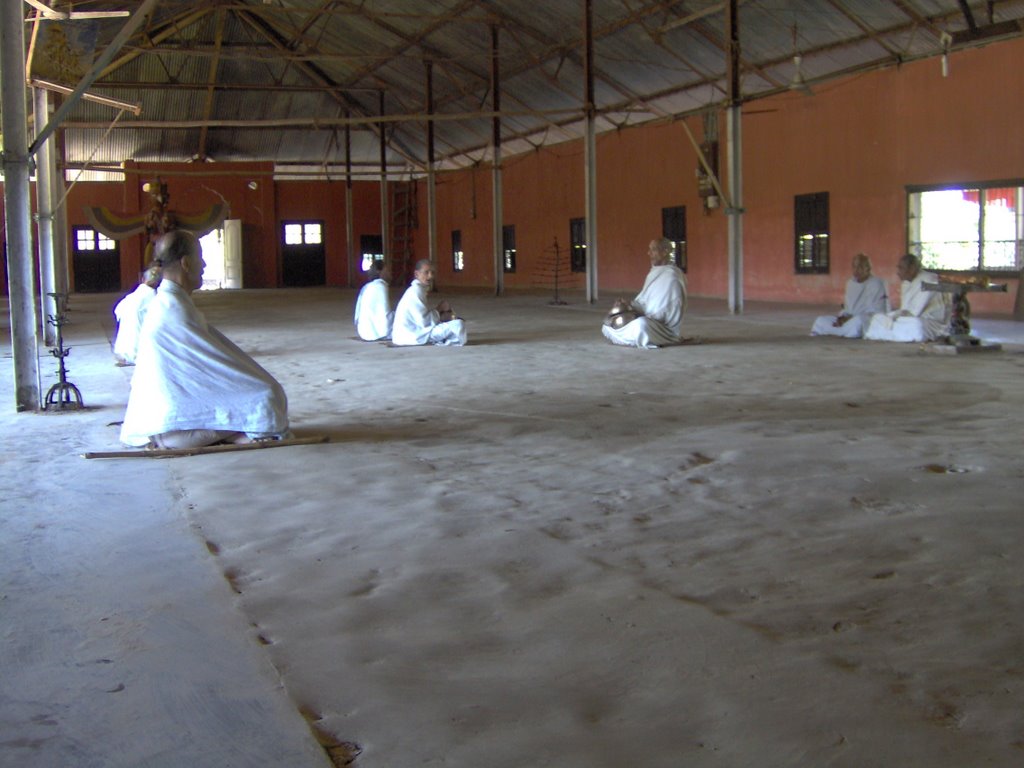
It took place in a cavernous hall that was about five times as long as it was wide. In the center sat four monks leading the prayer, with fifteen other devotees who ranged themselves in no particular formation along the walls and pillars of the massive hall. The prayer itself was like a mix of a Buddhist chant and a muezzin’s call to namaz, and just as I’d come to terms with that unlikely juxtaposition, I’d be started by a loud yell followed by staccato “Hare Ram Hare Krishna” repetitions. I was mesmerized.

But I digress. Back to dinner, and watching with awe as Dulal took another large helping of rice. By now, he had already eaten more than Vik and I combined. “What’s a typical day in the life of a monk in Majuli?”, I asked.

“Oh, it’s very easy”, came the reply. “You only have to pray fourteen times a day and take good care of yourself and your satra. Otherwise you are free to do as you wish. I myself have two businesses. Besides the guesthouse, I also have a stationery shop in Kamalabari town…what’s wrong? You don’t like your food?” He was looking at Vik, who had barely made a dent in his rice mountain.

“No, no, I’m just a slow eater”, Vik assured him, picking up his plate and wolfing down huge mouthfuls of dal-chaval in a show of respect. Dulal looked pleased. “You know, you boys are different from most Indians. Most of them don’t care about our beliefs and way of life here. Some of them even come all the way, over many roads and crossing many rivers, and when they get here, they refuse to remove their shoes at the gate. So they go back without learning anything.” He puckered his lips. “That way, foreigners are much better.”

After dinner we bid farewell and, pleased to see our shoes lying untouched in the middle of the road, returned to the guesthouse. There, my feeling that Lewis Carrol was messing with me returned when we met Peter, an English traveller from another era altogether, who while using expressions such as ‘Magical Mystery Tour’ and ‘Yankee’ as if they were still part of everyday lexicon, told us a story of being in Sri Lanka in the early 1980s. A young man walked up to him and said, meaningfully, “I’m a Tamil tiger.”

“Pleased to meet you”, Peter replied, wondering what he meant but hoping not to be rude. “I’m an English elephant.”

In Majuli, as I would see over and over again, you get all kinds.

——————————–

Acknowledgement: My travels in the northeast were partly made possible through the support and encouragement of Pravah, a Delhi-based organization that is “dedicated to equipping young people with skills essential to building sensitivity and responsibility towards the society we live in, and developing them into positive Changemakers of the future.”

Posted in Travels in Northeast India | Leave a comment

Sardines in Paradise

Here is this month’s column for First City magazine. Comments more than welcome.

—————————————

Sardines in Paradise

When you imagine great road trips, I’ll wager that sitting hunched up in a Tata Sumo cheek-by-jowl with nine other passengers isn’t one of the images that pop into your mind. And especially not when the driver negotiates steep curves by holding the steering wheel with one hand and using the other to support his weight as he leans half-way out of the vehicle, preferring to watch the road free of such nuisances as a windshield. Yet such trips in the hills and valleys of Arunachal Pradesh, where this shared-taxi system is the only economical way of travelling if you don’t have your own car, can often leave you with lasting memories. And bruises.

We set off from Tezpur in Assam, close to the Arunachal border, on a road trip by shared-taxi that would see us cover over 1500 kilometres in 53 driving hours spread over two weeks in Arunachal Pradesh. The pervading Assamese landscape of paddy and mustard fields on deforested lands prevailed right till the border, but as soon as we entered Arunachal, the world changed. Now we were climbing gently through lush virgin forests broken up occasionally by short flat valleys through which gushed dark-green broad rivers. Waterfalls cascaded and leaves reddened in the early winter as we made our way to Bomdila, our halt for the night en route to the monastery town of Tawang.

An Unexpected Bond

Bomdila is a grubby little town in western Arunachal Pradesh with nothing particularly to recommend it apart from a decent library. The next morning, a Monpa tribal boy came to serve us morning tea. As he was leaving, he turned hesitantly and said, in Hindi, “Sir, you watched the match last night.”

The previous night, India had come from behind to square the one-day cricket series against South Africa, which I watched amidst frequent power failures. The policy in Bomdila appeared to be that half the town would have electricity at any given time. After about an hour, they would lose power and the other half of town would switch on.

“Yes. And India won”, I replied. He nodded and repeated, “Yes sir, India won the match.” At that moment, in that meeting of eyes, I became aware of our differences. In age (I am about 10 years older), class, ethnicity (he a tribal, me a South Indian), and language (neither one of us spoke Hindi particularly well, and we’d had trouble understanding each other till then). But on that chilly winter morning at 8am, at an altitude close to 12000 feet in a remote corner of India’s remotest state, our two worlds crossed paths in a unexpected bond over the success of the Indian cricket team.

Soldiering On

After tea, we set out for Tawang, a trip that would take nine hours to cover just 190 kilometres due to the winding mountain roads and the propensity of our driver to stop frequently to pile even more people into and on top of the jeep. As we left Bomdila, I began to see glimpses of Monpa tribal life: here a woman quarrying stone, there some men laboriously chopping wood, here some children rolling bundles of firewood down the road and jumping on board for a fun ride, there an old lady plucking palak and tossing it into the wicker basket she carries on her back but supports with her forehead. Their wooden huts were supported by long poles angled into the side of the cliff; giving a sense of houses literally hung out to dry.

Further down we reached a landslide and while we waited for it to be cleared, I began chit-chat with some of the ubiquitous soldiers. “You’re going to see Tawang?”, they asked.

“Yes, it’s great isn’t it?”

“Nah, it’s ok. No need to come so far from Delhi. You can see the same in Manali or Nainital.”

Fortunately the road was cleared by then, saving me the trouble of raising my eyebrows incredulously at the soldiers. For I had already seen enough to know that Arunachal is incomparable to the bored hill-stations north of Delhi.

By now, it was time for a breather from the winding hills. We descended to the stunning valley settlement of Dirang, with cottages and huts set along the frothy banks of a river that tossed and turned its way down from glacial Himalayan peaks. Outside the town, terraced fields with carefully demarcated plots of cultivable land, each with a house at one end of the property, seemed like humankind’s inevitable attempt to impose order on nature, no matter how awe-inspiring that nature may be, by imposing order on itself. Climbing again, the vistas that unfurled themselves from the windows of our sardine-packed jeep were sufficiently gasp-inducing to distract from the steadily increasing aroma of unwashed bodies (ours included) mixed with gasoline fumes and oily snacks.

We needed to climb through to Sela Pass which, at 13700 feet, guards the entrance to the district of Tawang. Getting close to the pass, the vegetation thinned out gradually from tropical to temperate to barren high-altitude desert and the snow-clad peaks began to play peek-a-boo through the clouds, giving them either a ghostly or mystical aura, depending on one’s inclination. The temperature dropped sharply and all of a sudden body odour could be overlooked by being thankful for all the body warmth.

Building roads in these isolated and rugged regions must be phenomenally difficult and kudos is due to the Border Roads Organization (BRO) for their impeccable work not just here but also in places like Ladakh, Nagaland and Sikhim. The BRO regiment in Arunachal is known as Vartak and, despite their road signs ranging from the paternalistic (‘Don’t Gossip, Let Him Drive’) to the mis-spelt jingoistic (‘Proude to be Indian’) and from the philosophic (‘Stop Existing, Start Living’) to the downright amusing (‘Safety on Road is Safe Tea at Home’), the scale of their achievement is no less wondrous than the region they have achieved it in. And they’ve smartly decided to stay and enjoy the place, as their manicured colonies with picket fences and evocative names like ‘Baisakhi’ indicate.

A Pig and a Priest

About an hour from Tawang, with shadows lengthening in the early twilight, we stopped for tea at a dhaba set typically in a broader-than-usual bend in the road. After amusing myself by taking photos of a stray cow eating a discarded whiskey crate, I turned around to see one of my co-passengers hacking away at the carcass of a pig. I had no clue that this bit of ‘luggage’ was along with us the whole time. It appeared that the enterprising salesman had seen an opportunity and decided not to waste any time. Suddenly tribespeople were materializing like ghosts from the woods and gathering around as our butcher cut off portions of the dried and skinned carcass, weighed them carefully, and negotiated a rate or a trade. Seeing my interest, the driver who himself had purchased a healthy portion of pork as his fee, sidled up to me and whispered, “Why don’t you also buy some? You can take it to your hotel and they will cook it for you?” At the thought of lugging a chunk of raw pig into my lodging, I summoned my best ‘Are you kidding me?’ look and he sidled away chuckling.

Post-butchering, we headed on, only to be halted at the outskirts of Tawang by a very animated Friar Tuck. Robin Hood’s gregarious pastor had been reincarnated as a Tibetan Buddhist monk. Plump and jolly, with a red laughing face to match his crimson robes, he was not shy of frequently hawking outside the window, stopping us all so he could do some personal grocery shopping, and finally hitching up his robe to join the rest of us in relieving our bladders. All fairly normal human behaviours of course, but to see them performed by a monk in full garb isn’t an everyday experience.

Eventually, after nine cramped and bone-jarring hours, we rattled into Tawang’s bustling main road. Later, in shared-taxi rides elsewhere in Arunachal Pradesh, I would witness other amusing, poignant, and beautiful situations and locales. (One that stands out is the sight of an Apatani man near Ziro walking along nonchalantly in shorts, slippers and a frayed shirt, with nose plugs in his ear, a dao (Apatani sword) in one hand and a fistful of bright red poinsettas in the other.) But for sheer variety and event, the drive from Tezpur to Tawang was one of the most memorable I’ve ever taken. Perhaps not quite of the sort that would inspire a Bruce Springsteen anthem, but a classic nevertheless.

—————————————————-

Acknowledgement: My travels in the northeast were partly made possible through the support and encouragement of Pravah, a Delhi-based organization that is “dedicated to equipping young people with skills essential to building sensitivity and responsibility towards the society we live in, and developing them into positive Changemakers of the future.”

Posted in Travels in Northeast India | Leave a comment

The Butterfly Effect of Kaziranga

As of this month, I begin a monthly column for First City, Delhi’s primary city magazine, on my travels in northeast India. Since First City doesn’t seem to believe in having a website, here is the first article. Comments more than welcome.

——————————————
The Butterfly Effect of Kaziranga

What does the name ‘Chocolate Albatross’ conjure up in your mind? Perhaps, for instance, one of those animal-shaped chocolates made for kids. How about ‘Yellow Jack Sailor’? Perhaps a grizzled pipe-sucking mariner out of Popeye or Moby Dick, or maybe even a pub on a pier.

Actually, the former is deep ochre offset by white, with a fondness for sunbathing. The latter possesses brilliant yellow and black stripes, and enjoys sitting on a log to preen. They both have wings that can flutter at blurry speeds, eight legs, a slender torso, and a pair of antennae. They endure a youth with enough identity changes to give a schizophrenic a complex, and after all that, they only live a couple of days. The Albatross and the Sailor are butterflies.

For city dwellers, one of the big impediments to stopping to smell the roses is that you usually inhale a lungful of carbon monoxide as well. And if you live in Delhi, your CO comes spiced with generous helpings of the Thar Desert. So we block our nostrils, put our heads down, and soldier on, always packing more into our schedules and dividing the day into ever smaller yet fairly arbitrary parcels of time. Surrounded by fellow time-keepers, we often forget how truly weird this is.

As a result, when my Hegel-quoting naturalist friend took me along on an expedition to transect (don’t ask!) butterfly populations in the Pan Bari woods outside the World Heritage Kaziranga National Park in Upper Assam, the first question that bubbled through my consciousness was, “How long will this take?” But, not being on any sort of schedule, I had no valid reason to ask the question; the impulse to do so was purely a result of the toxins of programmed city life.

So I bit my tongue and reminded myself that I was here to detox from Delhi, as we strode through a narrow path between rows of tea shrubs in the picturesque tea gardens that outskirts the woods. Soon, with my expert guide pointing out exotic butterflies such as the Plains Cupid and the Gaudy Baron, in addition to our friends the Chocolate Albatross and the Yellow Jack Sailor, I was engrossed in watching the graceful yet rapid comings and goings of these vivid will o’ the wisps of the woods. Gradually, I was able to forget the time passing, forget the metropolis I had left behind, forget even the presence of the massive mammals – rhino, elephant, tiger, water buffalo – in the National Park nearby, and focus on the remarkable range and quantity of butterflies and dragonflies inhabiting these few hundred metres of forest.

Butterflies intrigue ecologists because, like frogs, they forewarn us about changes in the ecosystem. Since butterflies are dependent on plants for nourishment during their caterpillar stage, diversity in plans naturally leads to diversity in butterfly evolution. Butterflies and plants co-evolve and therefore changes in butterfly diversity and behaviour can indicate changes in flora, which in turn indicate changes in the ecosystem that we humans are part of and depend on. So butterfly ‘sinks’ such as the Pan Bari woods provide excellent spaces in which to study and observe butterfly diversity over periods of time.

This, however, is a whole other species of time than the one we city-dwellers attempt to tame. And time is a slippery concept here in northeast India. When you’re just here to travel and you can immerse yourself in the rhythms of nature, time can seem irrelevant. Yet, this region is geographically east of Bangladesh (which is 30 minutes ahead of IST) but exists in time with Delhi. Thus, in winter, dusk is around 4:00pm and pitch darkness arrives by 5:30. Which means that time has profound implications for economic activity, not to mention its social and political consequences for youth who have no daylight after mid-afternoon in a deeply troubled region where authorities regard groups of young people with suspicion. So, when you say that Arunchal Pradesh is behind the times, you’re not just being figurative.

But I’m not here to change public policy. I’m here to leap over streams that are too wide to jump and land face down in the slippery water just short of shore and, much too often for my liking, stand on one leg like a stork in order to pluck slippery leeches off the other leg. All this to provide merriment to the butterflies in return for their silent lectures on stripping away time.

It’s a valuable lesson. When we return home, I’m informed that I will be woken up at 4:30am to clamber aboard an elephant sailing a sea of wild grass in search of the last remaining one-horned rhinos in the world. At first, I balk at the timing, and spend the evening jokingly grumbling about it. But when the knock comes the next morning along with a pot of tea and chocolate-cream biscuits, it’s really not that hard to shake off sleep and venture into the dawn.

But old habits die hard and so life throws up another test. Sitting on the elephant is a challenge because elephant saddles – like sleeper berths in trains and seats in buses and Air Deccan planes – discriminate against tall people. So, much to the annoyance of Ramu the mahout, my legs dangle off the saddle precariously close to the pachyderm’s ears. The real challenge comes when we enter the ‘elephant grass’, which literally is grass as tall as an elephant. Away from the saddle, my legs get tangled in the grasping grass and I’m forced to spend as much time trying to stay on board as looking around for wildlife. But just as I’m cursing all and sundry, and especially my idiocy for trying to overcome years of not being a morning person, the grass clears and in the swirling early morning mist, we come upon our first rhinos of the day. And my first rhinos ever.

I feel like I’ve passed a test. For the moment, at least, because trying to get around in the northeast is not recommended to those in a hurry. Nevertheless, this is a timeless ecosystem, as the ruminating rhinos remind me. They needn’t have bothered. My friends the Albatross and the Sailor were way ahead of them.

————————————————-

Acknowledgement: My travels in the northeast were partly made possible through the support and encouragement of Pravah, a Delhi-based organization that is “dedicated to equipping young people with skills essential to building sensitivity and responsibility towards the society we live in, and developing them into positive Changemakers of the future.”

Posted in Travels in Northeast India | Leave a comment