How You Play the Game

About a year ago, my friend and colleague Mille Bojer invited me to write an essay for a booklet she was compiling on “Changing the Game”. The booklet was based on an article written by Mille in which she argues that we need to fundamentally transform the way we approach life and our roles in this world, as individuals and members of various communities. Mille and I are members of a global community called Pioneers of Change, and this booklet was an attempt at a global dialogue amongst PoC members around this idea of Changing the Game. I joined 10 other Pioneers from around the world in sending in a reflection. The original booklet can be downloaded here, and I recommend it highly, especially Mille’s lead article.

Here is what I wrote, below. Comments welcome.

—————————————–
How You Play the Game

Mille discussed James Carse’s framing of finite and infinite games and I want to reflect on that a little because I agree that it has deep implications for the ‘Transformation’ approach. To quote Carse, and then Mille,

““A finite game is played for the purpose of winning. An infinite game for the purpose of continuing the play.” The dominant games we are playing in modern society are finite games. Life itself, as I understand it, is the great infinite game…Carse’s book is less about the actual games than about what kind of player we choose to be. We can choose to be finite or infinite players. The main difference essentially is that infinite players engage in finite games well aware that they are finite games. They choose consciously to play as long as it doesn’t jeopardize their infinite game. They don’t take the finite games too seriously.” [italics mine]

What does Mille mean by “Life is the great infinite game”? I hear it as, what is our infinite purpose? I brain-dumped possible answers this question might elicit and came up with: happiness, love, providing a better life for our children, continuing our cultures and traditions, leaving a legacy, getting to heaven/paradise, attaining enlightenment, living in the moment, living for the moment, and working for something greater than oneself. I’m sure there are other possible answers as well; and to each their own.

With so many infinite games being played, it matters more than ever how we play the game. Pierre de Coubertin’s Olympic Games creed claims that what matters is not whether we win or lose but how we play the game. In finite games, this is naïve, as any sportsperson will tell you – although we must play fair and know how to win and lose graciously, winning is still bloody important. I play my finite games to win. I’m intensely competitive on the cricket field or squash court. I use the stock market to supplement my meager NGO salary. I submit occasionally to the annoying rituals of courtship because I am looking for love. In all these, I win some, I lose some. And when I win, someone else loses. But they’re finite games, they ‘don’t jeopardize my infinite game’, and I don’t take them too seriously.

In infinite games though, how we play becomes paramount because, by definition, there is no victory – it’s the unreachable star. The closest thing we can come to winning an infinite game is the knowledge that we have played it both honorably and well; as de Coubertin (and several others) put it, “the most important thing in life is not the triumph but the struggle.”

One of the ways in which we can know how well we’re playing the infinite game is how good we are at sticking to our principles, to what we hold most dear. One of my principles is non-violence. In his book The Age of Consent, George Monbiot argues that we won’t know we are succeeding until we are resisted violently, because those that are benefiting from the status quo will oppose our attempt to change it. To bring that argument to this debate, we won’t know if the transformation approach is working unless is it violently resisted, because of the vested interests in maintaining the current structure. I pray we won’t encounter violence but I do agree that no change is painless and that many people benefit immensely from the current structure, so I have to admit that violent resistance is a possibility. How will I counter that? Not with violence, I hope, because of my non-violence principle.

I bring this up because it illustrates the importance of how we play the game. To use violence – and not just personally, but also in the person I vote for or the organization I work for or the company I invest in – would mean I’m not playing honorably; hence losing the infinite game, or coming as close to losing it as possible. But non-violence is not easy at the best of times, let alone in times of personal danger or great anger. It is a huge challenge.

As are all infinite games. Brought up in a world that likes Hollywood endings and encourages instant gratification, not knowing the result of our game can be both frustrating and discouraging. Often we may not even have tangible milestones to chalk up as signs of progress. The way I’ve decided to compensate is to always seek to play the game with principle. If I take care of the ‘how’, then not having a result matters less.
Posted in Social Change | Leave a comment

Steve Waugh – The Opposite of Ice

Two years ago, a couple of weeks from today, the man who, after my Dad, has taught me the most about life played his last Test match. A few weeks ago, he released his autobiography, which he claims to have written by hand and not on a computer. By all accounts, the book is excellent, with an introspective honesty not often found (or expected) in sports stars. A few days ago, I pleaded with a bookstore in Calcutta to open the shrink-wrap for me to salivate over the 700+ pages of a book I can’t wait to read. Christmas can’t come sooner.

The release of the book reminded me of an essay I’d written on Steve Waugh after he retired, mostly to try and understand why he’d been my favourite cricketer for over a decade. I half-heartedly tried to get it published then, with no luck. But I didn’t push it because I somehow wasn’t ready to send it out into the world. Times have changed, though, so here it is. Comments welcome.

—————————————-

The Opposite of Ice

Fire not Ice

My first memory of Steve Waugh dates back to when, as a seven-year-old just fallen in love with cricket, I watched him castle Maninder Singh in that thrilling final over at the start of the 1987 World Cup. Maninder’s shattered stumps sealed an improbable victory for Australia and commenced an even more improbable march to the first of their three World Cup wins. His performances in that World Cup earned him the sobriquet ‘Ice Man’ and, ever since, references to ‘Ice Man’ and clichéd puns on ‘war’ have rarely been absent from any writing about Steve Waugh.

And there has been plenty of writing of late. Even before his last curtain call, rainforests of paper and masses of cyberspace eulogized the gritty yet glittering career of the most successful captain in cricket history. But little, if any, of the writing dealt with what we can all learn from Steve Waugh.

Ironically, I can’t think of a nickname less encompassing of Steve Waugh than ‘Ice Man’. Of course I understand that it refers to his seemingly nerveless bowling and batting in a crisis but, to me, Waugh has always been about fire, not ice. And his story (and what I have learnt from him) is one of controlling your fire so it works for you.

When he began his career, Waugh was a bit of a hothead. He was an impetuous stroke player – a compulsive hooker – with a motor mouth. Over time, he changed his approach so that the flames went out of his batting and into a mind that ruthlessly channelled that fire to spur himself on and to irk his opponents. Waugh calls his psychological pyrotechnics intensity; and intensity, Rahul Dravid says, is the word that for him defines Steve Waugh.

Stories of Waugh’s intensity are now part of cricketing legend. There is the apocryphal sneer at Herschelle Gibbs on ‘dropping’ the World Cup, the story of the teenager whom Waugh sledged so brutally in a club game that the kid went home and ripped Waugh’s posters off his bedroom wall, reports – including a recent one by Javagal Srinath – of how Waugh has walked in to bat with his team in disarray and immediately begun barracking the rampant bowlers. And no one who saw it will forget the image of Waugh standing nose-to-belly with Curtly Ambrose, practically waving the famous red hanky as Ambrose stamped his legs and blew smoke out his nostrils. Some of these stories are true and others are myths, but fact or fiction seems irrelevant here because we know Waugh is capable of having said or done most things ascribed to him. It’s the intensity that makes it all so believable.

A Fisher of Men

Watching the Indian team clobber a weakened Australian bowling attack in Sydney, Ravi Shastri observed that Waugh was not as great a tactician as Mark Taylor when the chips were down, thereby making Taylor the better captain. Nonsense. Taylor pales in comparison to Waugh because, irrespective of tactical ability (and lets not forget Waugh’s inspired tactics on that crucial first evening of the Melbourne Test), he wasn’t a better all-round leader and he certainly didn’t have the same influence on the game.

Writers far more illustrious than I have catalogued the way Waugh’s Australians have changed how cricket is played, from intimidatory batting in Tests to the embracing of foreign cultures as a way to play better abroad; these innovations are now copied with great success by other teams. Mr. Shastri is well within his rights to prefer Tactician Taylor to Visionary, Innovative Waugh, but I respectfully disagree.

Another frequent jibe at Waugh is that he inherited a great team and so was simply lucky. But did he? Granted Glenn McGrath, Shane Warne, Mark Waugh, and Michael Bevan were finished products when Waugh took over, but Ricky Ponting, Matthew Hayden, Adam Gilchrist, Damien Martyn, and Justin Langer all either received their starts under Waugh or came into their own only under him. Of the hundreds of descriptions of great leadership I’ve read, across disciplines, my all-time favourite one is simply this: getting people to a place they would not get to on their own. When some of your most important teammates publicly acknowledge your influence on their lives, as all the ones named above have done, you’ve led with distinction.

Finally, and perhaps most importantly, Waugh has somehow made his intensity infect the team. Under Taylor, the Australians would win series’ but usually draw or lose a match or two along the way. Under Waugh, clean sweeps became so commonplace that it’s easier to remember the times his team didn’t sweep a series than when they did. Intensity is difficult to sustain for all of us – even if you love your job, think of those times in your career when your mind drifted and your productivity slipped. Or, for a cricketing comparison, think of the Indian cricket team and how it slips from the sublime to the mediocre with effortless ease. Historically, our team cannot sustain the intensity that the Australians can. The ability to sustain intensity and complete whitewash after whitewash is tremendous, and that it is now expected is a phenomenal achievement. Taylor fed his team many a succulent fish, but Waugh taught his men how to fish.

Intensity can of course boil over and it is ugly when it does. McGrath’s run-in with Ramnaresh Sarwan is an example, and we in India well remember Michael Slater’s attack on Dravid. Waugh has, it must be said, failed to rein his players in at times, and he deserves criticism for it. But such confrontations are also the inevitable by-product of unceasing intensity and a game dedicated to all-out attack. Right or wrong, this may be how Waugh sees it; and, blemishes included, this intensity defines Waugh’s team.

Mental Toughness

Watching Waugh on the field, baggy green cap on head, slit-eyed and thin-lipped, it is easy to imagine him starring in a spaghetti Western. And like the gunslingers that define those movies, Waugh is as tough as they come. But with him, that toughness comes not from an imposing physique but from a mind that directs fire and channels intensity.

Waugh once told Justin Langer that mental toughness is not giving in to yourself. For a gripping demonstration, look no further than Australia’s last visit to England. In the final Test, with the series already won, Waugh batted for over five hours with a serious calf injury to score an unbeaten 157. Some suggested that he was thumbing his nose at the English team, several of whose players pulled out of matches with far less serious injuries. Again, whether true or not, it’s believable, isn’t it? The pain was immense – and the effort had further consequences on Waugh’s health – but he steeled himself and batted on, defeating not just the English but surely also his own demons and better angels.

Learning from a Master

So what can we – all of us, no matter our age, sex, profession – learn from Steve Waugh?

Sunil Gavaskar once wrote that the unfortunate aspect of the developed world is the undeveloped mind, which is not willing to soak in new experiences. After Steve Waugh, this is no longer a criticism levelled at touring first world teams since he has demonstrated the benefits – both to one’s game and one’s person – of actively seeking out new experiences in foreign lands. This is an attitude that all of us should emulate, in our professional and personal lives. And its fun!

We can also learn to respect tradition and history, and derive inspiration from them, but not be limited to them either. Waugh has instilled this ethos into his team. We can learn that many of us – in fact, I wager this holds true of every single person reading this sentence – are remarkably privileged to have the education and life-conditions we have, and that we should give of ourselves and our resources to benefit those without our luck. Waugh’s philanthropic work in Kolkatta has made him a hero there. We can learn that our world can always be shaped in different ways as long as we envision things being different, and that we can do the shaping. Waugh has changed the way cricket is played.

We can learn that loss and suffering are inevitable but it is how we respond to them, or how much lemonade we can make from life’s lemons, that defines us. Steve was dropped for his brother, and came back stronger. When the Indian team gate-crashed his farewell party, he responded with a match-saving final innings that personified him. He leaves with a full jar of lemonade in his kit bag.

We can learn that, with a little discipline, we can make our inner fire work for us and not against us, and that the benefits of this will surprise even ourselves. We can learn that it is imperative to walk the talk, if we are to hold our head high. Waugh does, which is why we believe the urban legends surrounding him. And above all, we can learn that to achieve greatness and distinction at what we do, our biggest challenge is to not give in to ourselves. To quote Rudyard Kipling,

‘If you can force your heart and nerve and sinew,
To serve your turn long after they are gone,
And so hold on when there is nothing in you
Except the Will which says to them “Hold on!”
…Yours is the earth and everything in it.’

Posted in Cricket | Leave a comment

Portrait of a Gigolo

“A model”, I first thought when I walked in at 10pm after a long day at the office and found him sharing a beer and a cigarette with my host. He had that deadly combination so carefully cultivated by models and film stars, simultaneously projecting both oomph and vulnerability.

His hair was jet black and shoulder length, gelled firmly into straight-lined good behaviour. A manicured goatee hung off an angular face that reminded me of a filled-out Johnny Depp. But it was when he stood to greet me that I really got a good look at him. He wore a thin frilly peach shirt that was transparent enough to display formidable biceps and the most perfect six-pack I’ve ever seen. The abs tapered to a slim waist which disappeared into carefully well-worn jeans that hung easily, almost happy to associate with such a body.

The shoes made me stifle a laugh though. Brown leather, polished shiny, they were long and narrowed to a pointy tip. I empathized with his toes. However, shoes, goatee and slightly overdone biceps apart, I’ve never seen a more outstanding example of my gender. By comparison, there I stood in T-shirt, faded jeans and sandals, (Yes, I used to wear that to work), stubbly, paunchy and badly needing a haircut.

We shook hands and sat down. I’ll call him Vinod. My host disappeared to fetch me a beer, leaving the two of us not knowing what to say. We obviously existed in totally different worlds. The usual small talk happened: where you from, what you do. He was from Indore and, to my surprise, a final-year Economics student. So that put him at, what? 20? 21? He looked at least 5 years older.

My host returned. Vinod stubbed out his cigarette and began saying his goodbyes. My host gave him taxi money to get from the suburbs to his downtown destination. He picked up the package he had come for and left.

Then I heard the story. My host has a good friend who is a doctor and gay. I’ll call him Henry. Henry is a lifelong Mumbaikar, in his late forties, wealthy, sophisticated, and somewhat arty. Every time Henry gets horny but is too lazy to cruise, he calls a pimp and gets a professional sent over. On one occasion, Vinod showed up. He was 18 or 19 at the time, new to Bombay, naïve, poor, slightly crude and didn’t speak much English. But Henry took a liking to Vinod and asked for him specifically the next time. Then Vinod made a clever suggestion. Of the Rs. 1000 he makes with each client, he has to give Rs. 400 to the pimp. So how about Henry calling him directly from then on? Henry agreed.

In a couple of months, the improbable happened. Henry and Vinod fell in love. Henry took the unsophisticated 19-year-old under his wing and started to groom him. Vinod pumped iron, improved his English and etiquette, brushed up on culture, and is now clearly eyeing a career in modelling or even in Bollywood. Today, two years later, Vinod is living with Henry.

They make a happy couple. If this was a movie, the story would end here, at this happily-ever-after fairy-tale climax. The down-on-his-luck gigolo finds a patron, stops selling himself, and begins climbing the social ladder. Perhaps the movie would even end with a ’10 years later’ montage in which Vinod is a movie star.

And perhaps he will be. Perhaps ten years from now Vinod will be a movie star, specializing in action flicks. Perhaps he will be dating his gorgeous, well-educated, city-bred, upper class female co-star. If so, he’d have probably changed his name to something like Bobby Khan and transformed his small-town origins into his USP, embodying a rags-to-riches, mofussil-to-metropolis, example of how Mumbai is the city of dreams.

But as the soulful Peter Starsdet song goes,

“Where do you go to, my lovely,
When you’re alone in your bed?
Tell me the thoughts that surround you,
I want to look inside your head, yes I do.”

Will a rapidly rising Bobby Khan ever re-visit Vinod? What will he then make of the boy from Indore who came to the Big City with stars in his eyes but no money in his pocket? Will he shudder when he remembers how he made that decision to sell himself to ageing queens?

And what of Henry? Will he then be a gracious old friend or merely a rung on a ladder that had to be stepped on in order to ascend higher?

Mumbai, as so many believe, is India’s city of dreams, our very own Land of Opportunity. There are those who pursue their dreams by day, standing sardine-packed in trains and working long hours, constructing daily the building blocks of future success. And then there are those who chase their dreams at night. Having moved from town to metropolis and from hostel to rich man’s bedroom, they have finally ‘made it’. They have gained entry to that top rung of the ladder occupied by the ultra-rich and powerful, where they can look out upon a seductively welcoming world that is their playground. It’s not only women who walk this murky road to fame and fortune.

And for the rest of us, do we ever consider what it must have taken to make such a decision, whether it be to gain entry to elite parties or simply for pocket money to sample some of what Bombay offers to the well-heeled? How did this process happen? Did Vinod arrive in Mumbai already hardened and, as the song goes, “touched with a burning ambition/to shake off those lowly-born tags”? Or was it the slow death of youthful innocence as he became aware of just what it would take to become a star, and will therefore “still bear the scars/deep inside”?

But maybe these are thoughts best left to Vinod. When he’s alone in his bed.

Note: Names and an occupation have been changed to give privacy to the individuals speculated about

Posted in Miscellaneous | Leave a comment

Book Review: Surface by Siddhartha Deb

My review of Siddhartha Deb’s Surface, that appeared in this month’s India Today Travel Plus. My brief was to focus on the travel aspects of the book. And it was eventually published with the title “Beyond the Surface”. Comments welcome.

———————

Pursuing the Unknown

Amrit, the protagonist of Siddhartha Deb’s second novel, Surface, is not at heart a traveller. He whiles away too much of his time and doesn’t usually see very far beyond his eyes. And in the end, his frustration with the outcome of his quest would leave a genuine traveller disappointed.

But what Amrit has in common with many travellers is his pursuit of the elusive – even illusive – unknown, which has always enjoyed a strange and compelling pull on travellers of all hues. Amrit stakes his professional future on this pursuit, right from the motivation to travel to India’s northeast based on an obscure German publication’s freelance assignment to his reluctant plodding along the trail, unable to forsake the quest even after leaving motivation behind in Kohima.

The assignment seemed straightforward on the surface: find out what happened to a young woman who had vanished in Manipur after being accused of pornography and paraded publicly by a vigilante insurgent group as a warning to others. Yet, as the novel’s title and theme indicate, this is a region where little is as it seems. Once Amrit begins probing he finds himself in a murky world where celebrated social workers have feet of clay, brawny military men yearn to be writers, infatuated young women are the firmest idealists, writers are forced to be counterfeiters, and where he himself continually struggles to find secure emotional and intellectual footing once he is beneath the surface.

Amrit begins his mission in Guwahati – an “old city…with the wide severe river that rested like a somnolent Leviathan next to the shapeless modern settlement, and the temple up in the hills where they performed animal sacrifices throughout the year” – and gradually makes his way through the Assam plains into Dimapur on the Nagaland border and from there to Kohima, where he pauses for breath and renewal before moving, now almost reluctantly, to his destination, Imphal. Unsurprisingly, as he is forewarned in Guwahati itself, the trail carries on to the smuggler outposts of Moreh and Tamu, on the Indian and Burmese sides of the international border.

Chunks of Surface are written with a journalistic or travelogue feel, as Siddhartha Deb plays with the blurry boundary separating fiction from fact. But Deb’s travel writing ranges frequently from the evocative to the dull, both of which can be found in the sentence, “tribal villages appeared in the countryside, conical reed hats on the men, the passing glimpse of brown breasts on a woman as she stooped among the plants.”

And yet, despite the choppiness, Deb deftly captures the feel of the northeast, from the challenge of finding a working telephone in Dimapur to the way a sudden burst of violence or a bandh can bring all life to a stop. Like so many before him, Amrit too feels an unaccountable attraction for Kohima, that “hill town with its pine-scented outskirts and tribal villages perched like bird’s nests on the surrounding mountains”, which despite being “taut with violence, anger and bitterness”, possesses a twilight that brings “a strange peace to the clouds brilliantly coloured by the…setting sun.”

When pursuing the unknown, being at ease with yourself and your place in the world often helps to prevent despair. The novel’s uneasiness with both brings an indefinable dissatisfaction for both reader and protagonist. But although Amrit fails to understand that most classic of travel’s commandments – that the journey matters more than the destination – Surface holds on to it, and that is finally the novel’s redemption.

Posted in Travel | 1 Comment

Lilting, Lulling Ranikhet

An article in The Hindu on the possibilities of a weekend getaway from Delhi to Ranikhet.

Posted in Travel | Leave a comment

Mixed Feelings about Mist

An unpublished poem

——————————–

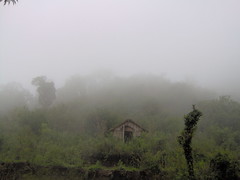
Naukuchiyatal. Mist dweller

I have mixed feelings about mist.

Because it obscures. Two weeks ago,
It prevented me from seeing the Trishul and Nanda Devi peaks from Mukteshwar
It prevented me from reading while settled in a boat in the middle of Naukuchiyatal lake.
It annoyed me. On these occasions, mist just…squats.

But even when I know what it’s obscuring
Even when it’s something I see everyday
The mist brings a tinge of mystique
That makes me crave the sight I can no longer see.
It intrigues me. On these occasions, mist swirls.

And it also reminds me of when
We first reached that village on Kilimanjaro
That was to be our home for the next 2 weeks
And a pair of Tanzanian women in psychedelic kangas
Carrying clumps of bananas on their heads
Ambled past us, into the mist.
And my Italian fellow volunteer turned to me and said
In an allusion to a movie set not too far away,
“Mujeras en la lluvia”
(Women in the mist)
It bemused me. On these occasions, mist engulfs.

And a week later, when we were halfway up Kilimanjaro,
And we sat down by Maundi crater
And munched chocolate,
Hoping to get a view of the peak.
The mist swirled in, filling the crater basin, whispering to us.
It calmed me. On these occasions, mist settles.

Annoyance, and it squats.
Intrigue, and it swirls.
Bemusement, and it engulfs.
Calm, and it settles.

Mixed feelings about mist.


Posted in Travel | Leave a comment

Reviving Ethics in Strife-Torn Kashmir

My essay in Changemakers.com on the pioneering work being done by Susheela Bhan to restore the ancient Sufi concept of Kashmiriyat in modern-day Kashmir.

Posted in Social Change | Leave a comment

The Social Entrepreneur

Excerpts from a longish article I wrote for the National Human Resource Development Network’s newsmagazine. This was about what it’s like to be a social entrepreneur, and about the organization that’s pioneered the concept of social entrepreneurship.

—————–
The Social Entrepreneur

Imagine this: You have an idea for creating change in your society, for the better of course. You may have hit upon the idea late one night or it might have come from years of work and experience. No matter how it came, the idea suddenly begins to occupy your thoughts. You can’t stop thinking about how to make it happen. It begins to possess you. And you know you won’t be happy just making the change in your colony or in your village, or even in your city. You want this change to happen more broadly. And you can see how to do it. You can imagine the method and the strategy, and can identify a host of obstacles and how to overcome them. So, you begin work on this idea, often eventually ceasing everything else to devote yourself full-time to this new idea to change the world a little.

You are a social entrepreneur, an incredibly rare individual but a phenomenally important one, because you and others like you are the drivers of sustainable social change all over the world.

But you’re human and so you have doubts about whether you should do this. It will be a long and hard road, probably with more setbacks than successes. You may not even live to see the fruits of your life’s work since real change happens so incrementally. More prosaically, you wonder how you will be able to support yourself and your family. You wonder how you can learn from people who have walked this path before and along with you. You wonder how to do enough work to persuade donors to believe in you and support you.

You might, then, look to Ashoka.

Ashoka: Innovators for the Public is a global non-profit organization that invests in social entrepreneurs because it believes that these visionary, innovative and relentless individuals are transforming not just their communities but also the world. Ashoka was founded in 1980 by William Drayton, an American who first put the word ‘social’ before the word ‘entrepreneur’. Drayton saw that the profound changes that transformed business in the West in the 18th and 19th centuries – innovation, competition, efficiency –were now starting to also transform the social sector. And that just as entrepreneurs had driven this change in business (from Andrew Carnegie down to Bill Gates, or from J.R.D. Tata down to Narayana Murthy), a particular breed of individual – the social entrepreneur – was driving this change in the social sector all around the world. These individuals have all the vision, creativity and determination of business entrepreneurs but are harnessing those abilities to solve social problems and sow the seeds for changing unjust or inefficient social systems, be it in education or health or environment or any other sector.

So Drayton founded Ashoka, an organization to identify and support social entrepreneurs worldwide. From a relatively young age he had been inspired by the story of Emperor Ashoka, who not only renounced violence and conquest after the Kalinga war, but also then dedicated his life to the public good. Emperor Ashoka was one of the earliest public entrepreneurs and thus, when Drayton set up his organization, it seemed natural to name it after the emperor.
…..

Over the last 25 years, countless potential social entrepreneurs have gone through a rigorous four-step selection process, and the ones too get through can call themselves Ashoka Fellows.

One of the first Ashoka Fellows Drayton found was Gloria de Souza, a Mumbai-based school teacher who had developed a system to make learning based less on by-hearting and reproducing information and more on independent thought and problem solving, especially for children in primary school. de Souza’s system focused on making the content of learning tangible and relevant to children’s daily lives, and thus had a focus on learning from the environment around the children. She called her system Environmental Studies (EVS) and, starting with the Mumbai government, managed to spread it far and wide until it became incorporated into the national curriculum.

Gloria de Souza’s story sounds exceptional. And it is. She is a one-in-a-million person, perhaps even rarer. But she is not alone. Today, Ashoka has identified and supported over 1500 such social entrepreneurs in 53 countries, with over 250 in India. And most of their stories are at least as exceptional and inspiring as de Souza’s.

Ashoka works on the theory that a little bit of assistance at just the right time in a social entrepreneur’s life can make all the difference in the world. It seeks to intervene at that very moment when the social entrepreneur is beset with doubt about the road ahead.
…..
Ashoka has spent most of its first 25 years promoting social entrepreneurship as a profession. Today, social entrepreneurship is gradually being understood and employed in people’s speech. Other organizations have entered the field of supporting social entrepreneurs. Universities and colleges all over the world are teaching social entrepreneurship as a subject, and sometimes as a concentration or a degree itself. With the rise of the social or ‘citizen’ sector around the world, more and more people are seeing social sector work as both financially viable and emotionally and spiritually fulfilling.
…..

Yet social entrepreneurship is as much as character trait as it is a profession. Social entrepreneurs are often serial innovators. Gloria de Souza’s EVS has evolved into the Environmental Studies Approach to Learning (ESAL), which focuses on developing the learning tools that enable extremely young children – in pre-primary school and early primary school – to begin relating to the environment in sensitive and informed ways. But a story that truly exemplifies this trait is that of Sonam Wangchuk, an Ashoka Fellow in Ladakh.

An engineer by training, Wangchuk was deeply disturbed by the education system in Ladakh, especially since the content of education was so far removed from Ladakhis’ experience that they couldn’t relate to it. Hence, the pass rates in board exams were abysmally low and even those who passed were not as equipped to succeed as children elsewhere in India. So Wangchuk set about transforming the system to make it more culturally relevant to Ladakh. He set up committees in every village that had a stake in improving the system and began to involve the students themselves in decisions regarding their education. His team worked with the government to re-write the textbooks to make them appropriate to Ladakhis. In just a few years time, the system was transformed. But, Wangchuk wondered, what about opportunities for young people after they finish school? He is therefore now putting in place the systems to foster a culture of business entrepreneurship in Ladakh, so that young people stop looking only to the government as a viable employer and become job creators rather than job seekers.
…..
Like a lot of social entrepreneurs, Wangchuk leverages but is not limited by his training. He is flexible across disciplines and not ideologically driven by one particular way of thought. He responds to problems by innovating to solve them. What allows Wangchuk and his fellow social entrepreneurs to do this is, fundamentally, the belief that they in fact can make a difference.

Social entrepreneurs from a very early age believe they were made to do what they are doing. As Drayton says, “social entrepreneurs are the cutting edge of democracy – they are demonstrating the power of citizens to change society through organizing other people to help the put their ideas in place.”

Posted in Social Change | Leave a comment

Zanzibar

A travelogue on Zanzibar, first published in Outlook Traveller in 2004 but no longer online.

————————–

Zanzibar

Whoosh! I broke the surface, arms flailing, looking wildly around. Where were they? All I could see was the open ocean, and the choppy water rolling around me. Then, Jan, a gregarious Dutchman, surfaced about thirty metres to my right and waved frantically at me. He pointed downwards in quick stabbing motions. Hope renewed, I slammed my goggles back on and dived, gazing expectantly around. At first, nothing. A flash of movement, and I looked down instead of around. What I saw made me gasp, and I had to force myself to breathe normally as I watched a school of dolphin serenely float not ten feet below me in the Indian Ocean.

There were seven dolphins, with two babies, and they swam close together, no doubt exchanging amused notes on the strange fish staring at them. They were at the very depth where the sun’s penetration ended – a solar deity was pointing them out to me, or so it seemed. I forgot all about my companions and even the mild panic that had been with me since the start (as a diffident swimmer in the open ocean). I just floated along on top of them, gazing in rapture, until they vanished into the darkness below.

******************

Zanzibar is located in the Indian Ocean off the coast of Tanzania. Known by locals as Unguja, Zanzibar was once a critical trading hub and has, at various times, dominated the lucrative spice and slave trade markets. The archipelago – Zanzibar consists of Zanzibar island, Pemba, and a series of smaller islands – was inhabited by a mix of Tanzanian Bantus and Arab traders until it became colonised, in turn, by the Portuguese, Omani Arabs, Germans and British. When it gained independence in 1963, Zanzibar joined hands with Tanganyika to form the Republic of Tanzania, although relations between the archipelago and the mainland have always been strained.

Nevertheless, Zanizbar is a little island with a little bit for just about everybody. For sun seekers, the beaches on the north and east coasts are excellent in all the idyllic lying-on-a-hammock-under-a-palm-tree-by-the-emerald-water ways that beaches have ever been described. For culture and history buffs, there are several minor ruins that give a fuller sense of Zanzibar’s Arab history. Sports lovers will delight in the island’s world famous scuba diving and snorkelling. For living culture enthusiasts, days can be passed just chatting with the friendly Zanzibaris under the shady awning of their shops. And then there are the show-off dolphins that leapt, dived, somersaulted and back-flipped as we went past.

For most travellers, the first point of contact with Zanzibar is Stone Town, a place well worth some quality exploring. The city is quite tiny, which at first I found hard to believe given how often I got lost in its labyrinthine maze of streets. But the smallness makes it just as easy to get your bearings as to lose them. I walked down narrow, curving streets, bounded by old concrete buildings on each side, often stepping into a shop to allow the traffic to pass by – on most streets there isn’t even room for two-way traffic let alone pedestrians.

Stone Town is a blend of old and new: timeworn facades with ornate engravings open quite often into modern showrooms or cyber cafes, low-hanging Arabic balconies covered with vines shelter street vendors hawking gimmicky handicrafts. It’s certainly tourist kitsch run wild but it also possesses an odd charm, a pleasant intermingling of the ages. There are more than a few decaying architectural wonders and, when I combined that with the salt in the air, the crassness became tolerable.

If poking around Stone Town is a quiet way to spend the daylight hours, then visiting the sea front at night provides a vibrant finale to your day. The Forodhani Gardens (a fancy name for two square lawns separated by a low stone wall), so nondescript in the sunshine, come alive at night with all sorts of cheap local food to die for. Watching calories here is futile so try the sumptuous Zanzibari pizza, which is like one of our stuffed parathas, but better. Add to that a baked cassava, a few donuts and a soft drink, and it will all be less than Rs. 50. Even for a budget traveller like me, that left enough dough to hit some of the nightspots that dot the seafront. These pubs cater largely to tourists so while I found enough diversity in drink and music, the only local ambience came from the setting.

Still, there aren’t many better moments in travel than turning away from the waterfront as the dhows come in for the night and quiet descends on the ocean, sipping some South African amarula or East African Kilimanjaro beer, and watching (or dancing with) elastic-bottomed Caribbean salsa queens ease you into a night of revelry. Zanzibar may be in Africa but it’s one global island.

The Information

Getting There

I went to Tanzania from the US, so you guys will have to check on airfares.

From Dar-es-Salaam, you can get to Zanzibar by either boat or plane. The boat costs about $35 and the fast one takes about 3 hours. An interesting option while returning is to take the night ferry, which allows you to spend a night at sea, although rough weather (I was lucky enough to get caught in a storm!) can make it a less-than-pleasant experience. On the plus side, you get to save on a night’s accommodation, so if you do take the night ferry, get there early to grab the best seats.

To enter Zanzibar, you need a Tanzanian visa.

Getting Around

Walk around Stone Town. For excursions to other parts of the island, you can get on a tour bus or take a dalla-dalla (picture a Maruti Van serving as a bus). If you use a taxi, bargain like hell.

Where to Stay

For backpackers and those watching their money, the Jambo Guest House is great value – $10 a night with some bargaining. The rate includes a free pick-up at the dock, a fabulous local breakfast and help with arranging tours. It also offers free movies and subsidized internet access. Rooms #1 and #2 are the only ones with A/C, wink wink.

For higher end travellers, and those staying overnight at the beaches, look up a guidebook. In general, the island caters to you so accommodation is not cheap and you should feel free to bargain.

What to Eat

The island does offer cuisine from all around the world but the Forodhani Gardens are simply a must. But be careful of uncooked food and beware of seafood out of season.

What Else to Do

Pemba: You can get to Pemba from both Dar-es-Salaam and Zanzibar by air or boat. Pemba is just opening up to tourists and contains better diving and snorkelling waters than Zanizbar but has little else to offer besides sun, sand and sea. Restless backpackers seeking peace and freedom from tourists are already exploring the other islands, but you’ll have to find creative ways of doing so since they are well off the beaten path.

Spice Tours: Zanzibar used to be a vital trading post because of its abundance of spices. Several operators offer tours in which you visit various spice plantations and sample crops ranging from cinnamon to jackfruit. As an Indian accustomed to all kinds of spices, I found it all less of a novelty than the Westerners did but since most tours also include visits to a couple of ruins and a beach, its worth the $10. Watching Westerners going goo-ga over nutmeg and cardamom is itself worth the price of the tour!

Jozani Forest: Located in the centre of the island. May be of interest to wildlife aficionados, although its offerings are pitiful compared to the grandeur of Tanzania’s other wildlife reserves.

Other Tours: There are a wide variety of tour options and these provide a relatively inexpensive way to visit several things at one go. One option I haven’t discussed elsewhere is to visit a nearby island (I’m forgetting the name) where you can tour an ancient prison, view giant turtles and red colobus monkeys, and get some snorkelling in. I had to choose between this and the dolphin tour on my last day, but I’ve heard that this is a good visit as well.

Shopping: Zanibar offers good shopping at all ends of the price spectrum. Clothes and handicrafts seem to dominate the market.

Tips

Take everything on word-of-mouth recommendations, but especially regarding tour operators and lodgings. Speak to as many travellers as you can before deciding.

Watch for street touts and con artists. The island is pretty safe but the overabundance of tourists can mask a great deal of poverty outside Stone Town. Take normal travel precautions and close your heart to the most pitiful of sob stories. A fool and her money are all-too-soon parted.

A little bit of Swahili goes a long way. Knowing the number system helps you bargain with the street vendors. And you’ll find that jambo (hello), asante (thank you) and the over-used hakuna matata (no worries) roll quite nicely off the tongue.

Bargain, bargain, bargain.


Posted in Travel | Leave a comment

Living High, Living Low in Tanzania

After returning from Tanzania in the summer of 2003, I wrote a long essay, which was then adapted by Travel Mag. This is the link to the adapted essay.

Posted in Travel | Leave a comment