Colombia’s Beauty Mania: Vignettes from the Curve Lines

Colombia is extraordinarily proud of its women. Before I arrived, every person who had been here (and several who hadn’t), whether male or female, would emit a quiet whistle and say “Colombia! Oh boy, the women there!” What’s the best way to learn Spanish? According to more than a couple of friends, get a Colombian girlfriend and in no time you’ll be fluent. While in Colombia, I get asked all the time, by expat friends, Colombian friends, colleagues, waiters, taxi drivers: “What do you think of our women?” It’s almost routine when you make polite conversation with a new acquaintance: “What’s your name? What brings you to Colombia? How do you like our women?” While travelling elsewhere in South America, other travellers often ask, “So, is it true about Colombian women being the most beautiful?”

Yet this lofty reputation comes at a price. Colombian women in a less demanding society such as the US often talk about the immense pressure placed on women to look beautiful in Colombia. When the mayor of Medellin spoke at my university in April, he mentioned that one of his policies has been to stop funding beauty pageants and replace them with talent shows, to encourage women to develop other aspects of their personalities. This is a radical shift because beauty pageants are a major feature of Colombia’s cultural landscape. In her terrific book on recent Colombian history, More Terrible than Death, Robin Kirk writes that there appears to be little excuse to hold a beauty pageant. In other words, not only do you have Miss Colombia, but you also have everything from Miss Coffee to Miss Banana. And at these beauty pageants, the camera zooms in to extreme close-up on various parts of the female anatomy, where commentators discuss with brutal honesty how this crown-hopeful has too much cellulite or how that one’s boob-job went awry. Like examining horses at a fair.

But why so many beauty pageants? Many believe they stem from the days when the drug cartels controlled Colombian society, and that it is the drug lords who not only funded the profusion of beauty pageants but also encouraged and facilitated the massive amounts of plastic surgery that take place in Colombia, particularly in the former cocaine capitals of Medellin and Cali. One friend, LC, after a trip to the Caribbean town of Cartagena, commented “On the beach, it seemed like the only real boobs were mine.” Another friend, PR, remarked wryly, “Who would have thought there would be a direct line from little white powder to the elimination of ugliness?”

But plastic surgery doesn’t extend only to what I had previously considered the usual places: breasts, lips, nose, face-lift etc. In Colombia, I discovered the existence of the butt-implant, a sight both equally silly and unmistakable when you see it. This might appear to contradict an assumption of plastic surgery: that you don’t want people to know you had it. In Colombia, however, women wear their surgical enhancements with pride. Yet, surgery isn’t all. I’ve also been astonished at the number of adults in Colombia who wear braces. At a party at the house of a US foreign service officer, I counted at least 25% of the adults wearing braces. And this isn’t just limited to Colombians: it appears that expats are taking advantage of the omnipresence of braces in Colombia to get their own teeth improved, something I daresay they wouldn’t risk doing back home.

There are, of course, other theories besides drug-power for why beauty is so much in fashion. A Colombian friend, AH, attributes it to the recent success of Colombia’s economy, which has given a lot more people more money to spend on beautification. But the same hasn’t happened in India or Korea or other recent locations of explosive economic growth. Another Colombian, EE, thinks that the weather has something to do with it because you see plastic surgery much more in the warmer climates of Medellin and Cali than in mountainous, chilly Bogota. “If you’re going to wear less because of the heat, it may as well be worth showing off.” But this too doesn’t hold when compared to other hot parts of the world.

Surely there are many interconnecting reasons for the obsession with beauty here, but the one that makes most sense to me is the gender ratio. Colombia has many more women than men, largely due to the five-decade long civil conflict in the country, and hence, there is a lot more ‘competition’ for available men than in other parts of the world. This in turn means that women have to go to greater lengths to capture a man’s attention. (A related common complaint amongst Colombian women is that there is almost no assumption of fidelity when it comes to Colombian men. My elderly Spanish professor once lamented that each man has, on average, seven girlfriends at a time. Even if this is a gross exaggeration, there is likely to be some fire underneath that smoke).

Personally, I don’t believe that young Colombian women are more beautiful than young women in other parts of the world. What I have noticed, however, is that older Colombian women look better (and younger) than their counterparts anywhere else I’ve travelled. The number of women who look 18 when they are 35, or 25 when they are 50, is astounding. And everyonedresses to kill.

It can’t be easy, however. To quote my friend SS “[I know a] Venezuelan who is absolutely stunning – I am not exaggerating, the woman is gorgeous, shapely, 5’10”, slim, dirty blond. Even women can’t stop staring at her when she’s in the room. Her husband is Colombian and she’s always talking about how she doesn’t feel pretty enough, skinny enough, feminine enough, etc when she’s in Colombia. And her mother-in-law is always pinching her, telling her to lose weight or clean herself up. And if you could only see her in person, you’d realize how absurd it is, she is near supermodel material. Scary what that kind of mentality does to a woman’s self-esteem.”
Posted in Miscellaneous, Travel | Leave a comment

Sixth Course, Session 9: Sergio Fajardo

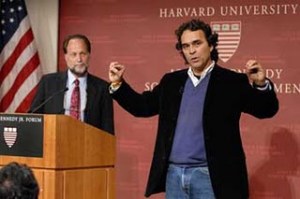
I was always going to be spending this summer in Bogota; for more than a year now, the universe has seemed to be conspiring to make that happen. But if anyone could have provided the inspiration to spend some time in Colombia, it would be Sergio Fajardo, the current mayor of Medellin, whose address made even myself consider joining politics. And if you know me, you’ll know that’s quite an admission.

Fajardo shared his scarcely credible success story of transforming Medellin from “fear to hope”, or from Colombia’s violent drug capital to a much safer and more pleasant city. A politician with a Ph.D in Mathematics, he conducted his political campaign by walking the streets handing out leaflets with his platform, and then just talking to people to find out what they really want.

Unlike most of the high and mighty suits that pass through our gates, Fajardo came dressed in jeans, a sweater and a sports coat. And rather than standing behind a lectern, he came out in front of it and addressed us with dramatic hand gestures and a tangibly strong presence.

Photo credit: KSG

There are two big problems in Medellin, he began. Inequality and violence (in 1995, Medellin witnessed the most homicides worldwide). If you are going to change a culture of violence, you need to be patient but you also need to act quickly and clearly, with no room for dithering about your policies. Fajardo began to do so by demobilizing the paramilitary soldiers – Medellin alone had over 4000 of them. But demobilization only works if you follow it with reintegration into society. Unlike other government programs, Medellin began to reintegrate its paramilitaries on an individual basis, with a strong emphasis on psychological healing and recovery.

To reduce inequality, Fajardo employed a strategy that originally came out of the social enterprise field – entrepreneurship training, particularly for the lower socioeconomic classes. Participants would take an entrepreneurship course (80 hours long) and then the best ideas for a new venture would receive seed capital ranging from $250 – $2000. Although not everyone would get financial support, all the students “get the education needed to change their minds and make them equipped to succeed.”

The twin drives to reduce inequality and violence have had mixed results, but certainly more successes than failures. And, says, Fajardo, “we get too obsessed with the failures. We also need to focus on and celebrate the successes.”

Another major problem in Colombia today is the objectification of women. This has apparently led to huge problems with eating disorders and extremely prevalent use of plastic surgery in Medellin. Under Fajardo’s tenure, no public money has been spent for beauty contests. “We are replacing beauty contests which are exploiting women to talent contests focusing on skills and minds”, Fajardo explained earnestly to the female student who asked him the question. “We need to change the focus from female bodies to female minds.”

Along the lines of Vaclav Havel, another intellectual-turned-politician, Fajardo spoke eloquently about the need for smart and educated people to enter politics and change its image back to a noble profession dedicated to serving one’s people. His bumper-sticker advice for all of us: “Study a lot, then go into politics. Its the only way!”

Perhaps it is. Perhaps not. In any case, the political profession is certainly richer with Fajardo’s presence. And I can’t wait to get to Medellin and see this for myself.

Posted in Harvard Sixth Course | Leave a comment

Sixth Course, Session 8: Ishmael Beah, Samantha Power, Dominique Villepin

This semester – which, thankfully, ended last week – was rather more manic than the last one, which is why my blogging became even more infrequent than usual. But that’s not to say the usual line-up of great speakers didn’t come through our gates. Mostly because I’m too lazy to write full pieces, here are some soundbytes from some of the best talks in the last four months:

Ishmael Beah

Ishmael Beah’s talk was expectedly filled with pathos, given his experiences and the astonishing journey he made from being a child soldier to a best-selling author. Much of what he said was remarkable, especially his bewilderment at how the question he is most asked on his book tour is “how many people did you kill?”. However the line that most struck me was when he was discussing another child soldier’s testimony before the UN General Assembly. Here is what he said:

“One of the UN delegates asked this child ‘At what age are you old enough to be a soldier?’ And the kid said ‘100 years’. And everyone laughed. But the kid then said ‘Because by that age you are either dead or too old to fight.’ And I realized the kid knew what he was talking about. Because, you see, in a war, it ultimately comes down to your life against someone else’s life. And all the reasons and politics and ideologies disappear in that moment, and it’s you against him. But when it comes to taking a life, no matter if you are 10 or 15 or 20 or 40 years old, the effect it has on you, either as victim or perpetrator, is the same. So the kid was right. There is no right age to be a soldier.”

Samantha Power

Miscellaneous quotes from our resident Pulitzer-Prize winning expert on genocide:

“A very discernable trend today is how US power is on the decline. I don’t mean our hard power as much as our political influence. Increasingly, people around the world are saying ‘we like your values but we hate your foreign policy’. But this gets twisted domestically and presented to the American public as ‘they hate our freedom, our children, our laughter’.”

“Other countries are asserting themselves more today – China, Russia, India – but largely in mercantilist terms. There is still a major space for moral and strategic leadership, which someone like Barack Obama can nicely fill in. We need to do better at telling and living the ‘values story’, to really be the ‘city on the hill’ again.”

“The problem with our foreign policy is that we base it entirely upon our security. Naturally, this doesn’t go very far abroad. To really improve our security, we need to invest in the process abroad, in long-term development.”

Dominique Villepin

The former Prime Minister of France was much more spirited and passionate in the Q&A session than in his actual speech, which mostly comprised the usual liberal fare about needing a new global order and the critical time we are in. He also shared a passionate defense of the ban on the death penalty. However, his best moment had nothing to do with direct politics. Instead, it was about what we can do to better prepare ourselves to be changemakers in the world ahead:

“The more you travel, the more you understand other people, other cultures, other ways of being. And thus the better you develop your personality, your creativity, your imagination, your values. And these are the barometers of success in the world today, much more so than a traditional academic education. It is critical to go through different experiences, to try different disciplines. Life is not about written material. If I see an 18-year-old who takes the risk to spend two years in China, I will say he will be more successful in life than the one who goes to a top-ranked university. So meet different people. Take risks. Life is good when you do that and these are things you won’t learn in a university.”

Posted in Harvard Sixth Course | Leave a comment

Stripping Off the Straightjacket: How Complexity Theory Provides a Whole New Approach to Making Policy

An essay/book-review in the 2007 edition of the Kennedy School Review.

——————————————–

Stripping Off the Straightjacket: How Complexity Theory Provides a Whole New Approach to Making Policy

Fritjof Capra, The Hidden Connections, Harper Collins, 2002, 272 pages

Mark Buchanan, Ubiquity: Why Catastrophes Happen, Three Rivers Press, 2002, 288 pages.

How is it that scientists have spent millions of hours and billions of dollars in trying to figure out when earthquakes occur without making much progress? How could an accidental wrong turn made by a chauffer in a busy Sarajevo street one morning in June 1914 have led to the greatest war the world had until then ever seen? Why is it that managers of the world’s largest organizations feel that no matter how hard they work, things are out of their control? Can we design a world in which the two great forces of global capitalism and ecological sustainability veer off their collision course and find a space to coexist productively?

In the last three decades, the quest to answer these big, baffling questions has sent researchers scurrying to all known corners of the intellectual universe. And, perhaps surprisingly, the discipline that has been coming up with the most compelling answers is physics. Yet physics only came to grips with these new areas of inquiry when it began incorporating insights from other fields. In the process, a new field of study – ‘complexity’ or ‘complex systems’ or, more technically, ‘nonlinear dynamics’ – came into being.

In a nutshell, what complexity does is to use metaphors and mathematical models to examine the way in which the many constituent parts of a living system network with each other to create new types of relationships and processes that often turn out to be just as important as the (more easily tangible) material parts of the system that get most of our attention.

Fortunately, for those of us less inclined towards scientific modeling, several physicists have taken on the unenviable task of simplifying complexity, so to speak. And they all seem to have followed the modern non-fiction writer’s modus operandi whereby you take an idea, explain it in a few chapters, and then write a handful of case studies to flesh out the concept further. The most eloquent of these physicists-turned-writers is Austrian Fritjof Capra, the author of the popular 1975 work The Tao of Physics, which explored parallels between modern physics and ancient religious teachings of Asia. Almost thirty years later, Capra capped more than a decade of research into living systems and network theory by publishing The Hidden Connections, in which he explains how every single system on the planet – from the smallest amoeba to the largest international organization – is essentially comprised of a series of networks along which information flows from one side of the network to the other, and every now and then jumps from network to network. Life, in one of Capra’s many evocative turns of phrase, “constantly reaches out into novelty”.

Extending this idea though the book, Capra first describes how insights from the ‘systems view of life’ have been revolutionizing the fields of biology, genetics, cognitive psychology, and sociology. For instance, the insight that the workings of the brain can be better studied in the context of the brain’s relationship with other brains and bodies than as a single unit of analysis has changed the way in which cognitive psychologists understand and study human consciousness. Confident of our grasp of the scientific material, Capra then shows how these insights can be applied to some of the greatest problems of the twenty-first century: from organizational management to biotechnology and from global capitalism to the issue that appears to most concern him – the design of ecologically sustainable communities. In these applications of complexity, we see the startling similarities between metabolic networks in biological systems and communication networks in social systems, or how flows of energy and matter closely resemble flows of information and ideas. For instance, compare the astonishing speed at which drug resistance spreads across bacterial communities with the efficiency with which peace activists in late 2002 mobilized hundreds of thousands of people in cities in every continent to protest the impending invasion of Iraq. Microbiology, according to Capra, “teaches us the sobering lesson that technologies [such as] a global communications network…often considered to be advanced achievements of our modern civilization, have been used by the planetary web of bacteria for billions of years”.

With this understanding that all life is organized as networks comes the discovery that networks of all kinds – molecules, people, even ideas – tend to organize themselves along remarkably similar lines. But one of the downsides of this way of organizing is that these systems are susceptible to the occasional small shock which unexpectedly triggers a cataclysmic reaction – the carelessly tossed match that ignites a massive forest fire or the ever-so-slight slip of the earth’s crust that triggers a devastating earthquake, and so on. Complexity scientists believe that this pattern occurs because of the tendency of living systems to self-organize into a “critical state”, which is a state where systems are at their most efficient but nevertheless contain “riddling lines of instability” that make them vulnerable to short periods of total collapse. (Incidentally, if this seems similar to the concept of chaos theory, that’s because it is – chaos theory was one of the intellectual forefathers of complexity theory, which is now taking the insights from chaos theory into new previously uncharted areas of exploration.) To better understand the critical state, Mark Buchanan traces the evolution and intellectual history of the ‘power law’, another concept central to the understanding of complexity. Buchanan’s Ubiquity takes earthquake science as its central case study and charts the painful failure of earthquake scientists to predict when an earthquake will occur and, more importantly since earthquakes occur all the time, how bad an earthquake is going to be. Eventually, earthquake science consoled itself by incorporating the power law into its worldview.

Social scientists and statistics students come across the normal distribution, illustrated graphically by a bell curve, in their daily work. The normal distribution reflects a natural tendency for any the quantity of any individual event to cluster around the average for that event – results that are farther from the average are less likely to occur. The heights of people, amongst other natural phenomena, are normally distributed. But what the power law tells us is that for a surprisingly large number of phenomena, this distribution does not hold. However, these phenomena do conform to another type of statistical distribution, which can be simply described as follows: as the scale of the event rises, the probability of its occurrence decreases exponentially. After examining thousands of such distributions, scientists concluded that each phenomenon conforming to a power law obeys its own individual ratio of size to occurrence. Hence, the power law of earthquakes is different from the power law of stock market crashes – in the case of earthquakes, every doubling of magnitude in earthquakes is accompanied by a frequency decrease of a factor of four.

Some of these power law distributions can be as mundane as the size of fragments from a shattered frozen potato. But others – and this is why understanding the power law is so important for policy makers – include the distributions of events as dramatic as the magnitude of earthquakes, the area burnt in a forest fire, the level of stock market crashes, the mass extinctions of species, and the number of deaths in wars. Unfortunately, what the power law also indicates is that predicting the scale of one of these catastrophes is nearly impossible because, as Buchanan writes, “an earthquake when it begins doesn’t itself know how big it is going to be. And if the earthquake doesn’t know, we aren’t likely to know either.” The same phrase can just as easily be applied to any of these other catastrophes.

Although complexity and the systems approach initially come from physics, what they emphasize most is the importance of not thinking within disciplines but instead to pay attention to relationships, context, patterns, and processes across disciplines. What makes this difficult, particularly in Western societies, is our imprisonment by the Cartesian division between mind and matter. Buchanan quotes Isaiah Berlin’s comment that the history of thought has been “a changing pattern of great liberating ideas that eventually turn into suffocating straightjackets.” In the seventeenth century, when Rene Descartes muttered “Cogito ergo sum” (I think therefore I am), he divided nature into two separate realms – mind and matter – which were meant to be studied separately and as different units of analysis, rather than as two realms that can best be understood in the context of each other. Thus, while Descartes’ famous statement jumpstarted modern philosophy, it also created a straight-jacketed framework for analysis that Capra believes has haunted and suffocated Western science and culture for more than three hundred years. For a simple example of this straight-jacketed framework, just look at the way universities are structured by academic discipline and how each discipline vigorously resists any movement towards interdisciplinary scholarship.

By instructing us to look across disciplines, complexity theory is in effect urging us to abandon the Cartesian way that has served us so decisively for so long. No wonder then that its journey to the mainstream has been excruciatingly slow and that despite three decades of increasing focus in this area, it still remains off the radar screen of most policymakers. Capra finishes The Hidden Connections by insisting that the crucial issue is not further research into complexity but politics. And thus, the great challenge of the twenty-first century will be to change not just the intellectual frameworks that govern policymaking but also some of its underlying value systems, in order to reflect the lessons that we are learning from complexity and the systems view of life.

Posted in Miscellaneous | Leave a comment

The Right Turning: Travel and Graham Greene

The essay below was commissioned by Outlook Traveller. They asked me for a piece on Graham Greene that reviewed 3-4 of his books, yet kept as focus the theme of travel in Greene’s work. However, since they haven’t published it in over two years, I’m assuming they changed their mind. As always, comments and thoughts are welcomed.

———————————————

The Right Turning

A year before he passed, my father decided to re-read every Graham Greene book he owned. Recalling that decision several months later, with curiosity stirred, I picked up The Power and the Glory, the best of Greene’s oeuvre, according to Dad and many of Greene’s other fans.

And I was transported into a world that I now recognize as quintessentially Graham Greene; a world where travel is central though often rather strange, where Catholicism is doubtingly heeded, where what you do matters more than who you are. And a world with some of the most haunting tales I’ve ever read.

Still, having read less than a third of Greene’s considerable output, I find myself gingerly embarking on this essay about an indisputable literary giant, albeit one whose motifs of violence and religion have made him, according to the Nobel Committee itself, too controversial to be awarded literature’s highest prize. But, as a pioneer of travel fiction, what does the master teach us about travelling?

A primary though perhaps obvious lesson is that travel can take several forms. The Power and the Glory is travel as adventure – the priest’s flight takes him through jungles, hills, rivers, plantations, and villages. Monsignor Quixote pays homage not just to Cervantes but also to that classic form of travel as recreation: the road trip. Travel can be an inner journey, such as the one Maurice takes in The End of the Affair to understand and accept Sarah’s departure and death. And in A Burnt-Out Case, when Querry journeys far away seeking solitude, he discovers the pitfalls awaiting one who undertakes travel as pilgrimage.

Another lesson is that there are universal aspects of humanity which surround and even perhaps engulf you no matter where you travel – be it the Mexican villages of The Power and the Glory, the Spanish countryside of Monsignor Quixote, the London suburbs of The End of the Affair or the Congolese jungles of A Burnt-Out Case. For Greene, one of these universal aspects was death; protagonists of all four books died either violently or prematurely. Another was religion. Greene’s own angst about Catholicism took shape in each of these books by juxtaposing the questioning believer against an atheistic doppelganger who inadvertently provides the believer with a mirror through which to examine and, eventually, retain their faith.

But if the same themes are everywhere, as Greene seems to say, then why travel at all? If the world now looks the same on the outside, with the increasing homogeneity of the ‘global village’, as well as on the inside, why not simply sit back in our comfortable armchairs and experience the world through the pages of this magazine?

Because, and this to me is Greene’s most profound statement on travel, your choices when you travel can irrevocably alter your life. The persecuted ‘whiskey priest’ of The Power and the Glory repeatedly turns back from the threshold of safety to help others in need, even, finally, at the cost of his own life. The amiable Monsignor Quixote chooses vitality by road-tripping with his Communist compañero even though it means his expulsion from the Church. Sarah beginsThe End of the Affair when she promises to leave Maurice if God ensures that he survives the bomb blast, a choice that destroys them both. And in A Burnt-Out Case, Querry attempts to snuffle his vocation and his fame in the anonymity of a remote leper colony, only to discover that he is too famous and too good at his job to escape either.

Old Robert Frost was spot on when he observed that it is the choice between two roads that makes all the difference. Greene expresses that sentiment through Dr. Colin in A Burnt-Out Case, who says, “Through trial and error, the amoeba did become the ape. There were bright starts and wrong turnings even then…I think of Christ as an amoeba who took the right turning.”

Like Christ, Greene’s characters often took turnings that destroyed them. Yet the process of turning, and the road they chose, also made them better than they ever thought they could be.

Posted in Travel | Leave a comment

Sixth Course, Session 7: Ramachandra Guha

Why does Ram Guha qualify for a ‘sixth course’ when recent big-wig visitors like Steven Colbert(entertaining but insubstantial) and John Negroponte (dull and insubstantial) do not?

Because Guha, as always, had polemical things of interest on his mind. He was here to speak about his latest book (reviewed here by Dilip) but most of the conversation revolved around the tension between being an activist or being an intellectual. I can’t quite put together a coherent review of his talk so I’ll instead list a series of soundbites that are either entertaining or worth thinking about and which (I think) together give a sense of what was said.

Note: Most of these are paraphrased.

1. I have moderate views, expressed in an extreme fashion. The older I get, the more moderate I become.

2. Students trained in America are much likelier to have the courage to take the interdisciplinary leaps required of environmental history.

3. Environmentalism is a modern phenmena produced by the Industrial Revolution and the nation state. To talk about Hinduism and ecology, or Christianity and ecology, is to speak in oxymorons.

4. Scholarship is full-time work, and so is activism. You can’t really be an intellectual activist. Yet, there are too many who proclaim to be just that in [India]…All of us have beliefs, ideologies, orientations. You need distance for scholarship.

5. The major cities in India – Delhi, Bombay, Calcutta, Madras, Bangalore – are having a transformative impact on the world. In fact, the ecological imprint of Bangalore is felt 150 miles away.

6. The curent state of the Ganga and the Yamuna today is directly a repudation of the claim that Hindus are ecologists.

7. When Medha Patkar testified before the US Congress, the World Bank withdrew from the Narmada Dam project and the Indian government became even more determined to make sure the project succeeded. Because, you see, India is fundamentally not a Banana Republic. The World Bank can coerce a Colombia or a Sri Lanka but never India – there is just too much nationalist sentiment in India.

8. Subaltern studies died when it was incorporated into the American academy.

9. 95% of the problems in India are caused by Indians. Forget about the World Bank and the WTO. Anyone who says these institutions are causing farmer suicides in Vidarbha is speaking utter nonsense. We have to look within for the answers. Because 95% of the solutions to India’s problems must also come from Indians.

Posted in Harvard Sixth Course | Leave a comment

Sixth Course, Session 6: General Abizaid

The “Mad Arab” came, saw and appeared to urgently need something to conquer. He wore his combat fatigues because, he said, after days of testifying before Congress, there was too much blood on his uniform.

He spoke well, with humour and vision, and tugged at the heartstrings with a lovely ‘call to service’ at the start of his address (which almost made me want to enlist in the US Army). He made an eloquent case that this is more a battle of perception than a military battle and that’s where the US needs to win this war. He chilled my spine when he declared that in today’s wars there are no civilians (not the vegetable vendor, not the Red Cross, not the most impartial newspaper). And he made a lot of international friends when he admitted publicly that the US could certainly be a lot humbler in the world.

But in the final analysis, what came through most is that the General, like everyone else, doesn’t really have a clue about how to stop this thing his bosses started. Sure, he can analytically list the three biggest challenges of this era for global security (Israel-Palestine, Shi’ite extremism, Sunni extremism) and come up with a to-do list. But the ‘how-to’ question remained glaringly unanswered. I suppose it’s possible that he does have the answer and isn’t telling us. Yet something in his body language and words makes me think it’s unlikely that even the Mad Arab knows something we don’t.

Posted in Harvard Sixth Course | Leave a comment

Sixth Course, Session 5: Pascal Lamy

Addressing a full-capacity Forum audience, Pascal Lamy began by rambling on metaphysically about the etymology of governance (Latin, ‘rudder’) and current trends in global governance when a bearded man suddenly stood up and began yelling “WTO means death to farmers, WTO means death to fisher-folk, WTO means death to healthcare…”

He was ejected by Security. Lamy went on. A few minutes later, another man in a red bandanna stood up in a different part of the audience and excercised his lungs in much the same vein. He too was ejected.

But by now Lamy was startled. Perhaps he didn’t quite expect protestors within the premises of the K-School. He gripped the podium with both hands, looked up at his audience, and said “Ok, let’s get into it, then.”

What followed was by some distance the best Forum lecture I’ve attended here so far. Lamy, in stereotypical French-accented English, was honest, admitting several things that are seriously wrong with the structure of the WTO but strongly holding to the fact that the organization is accountable, democratic, has robust dispute mechanisms, and is not solely concerned with the welfare of the rich and powerful.

Throughout his speech, he was interrupted by what was clearly an organized bunch of protestors, who knew fully well that anyone who yelled out would be thrown out, and began to receive scattered applause for their persistent interjections.

But Lamy too went doggedly on. Yes, he said, the basic premise of the WTO is that open markets are good because they facilitate the greatest efficiency of trade, but the WTO is also concerned with the environment, human rights and public values, all of which individual governments are free to prioritize over trade if they choose to. In fact, he even went so far as to say that trade restrictions in the future will increasingly be values-based.

Yes, he admitted, the biggest stumbling block today is agriculture, where the US (high subsidies, low tariffs), the EU (high subsidies, high tariffs) and India (high tariffs, low subsidies) are slugging it out while the rest of the world takes a “coffee break”.

Yes, he agreed, there is a bias against developing countries in the rules of the game and unless those rules are changed, the WTO will remain stuck where it is. But, he insisted, the problem is with politics, not the process.

Still, as the questions became more and more pointed – not so many from undergrads, thank goodness – Lamy’s practised veneer began to crack. The already eroding party-line evaporated into the cauldron of the Forum when he admitted that his hands were tied by the members of the WTO and that if we wanted to make things better, we need to go as far as fundamentally changing the Westphalia System of 1648.

Yes, he carried on, political decolonization happened fifty years ago but economic decolonization is only now starting to happen. What his member-constituents made of these admissions I have no idea but Lamy’s own private views seemed reasonably clear: the WTO is not the devil but it is unequal and we need to change that.

The protestors were annoying and the questioners were impressive, but if together they combined to make the head of the WTO publicly admit the organization is fundamentally unequal, then everybody did their jobs.

Posted in Harvard Sixth Course | Leave a comment

Sixth Course, Session 4: Jaswant Singh

I’m left smiling at the irony that in India I’d almost never be in the same room as the leader of the BJP but here I get to sit across the table from him and eat lunch.

Jaswant Singh was here last month for a few brief weeks as a Fellow of something or the other – I forget what. During this time, a group of us (students, big-time professors and other assorted big-wig India watchers) had the opportunity to eat lunch with him. Unfortunately, everything that was said at that lunch is ‘off the record’ so I can’t actually quote him. But, like most who have seen him speak, I was impressed by his breadth of scholarship, perspective and honesty. There is a little of the practised orator about him: he begins sentences softly, appearing to be deep in thought and slowly gathering his argument together but as he gets to the middle of his response, his voice picks up steam and he ends by looking straight at the person he is directing his answer to and finishing with a resounding take-that firmness.

He was especially candid about US Foreign Policy (in particular regarding Afghanistan, Iraq and de-nuclearization), once responding to a probing question asked by a retired General with what can only be described as a smackdown – even those of us who disagreed with the General felt sorry for him after that. Singh was more diplomatic about India but not overtly so, and of course scathing about the current government.

Frustrated though I am not to be able to write about all the interesting things he actually said, I feel I can end with this: the man has the bushiest eyebrows ever. I couldn’t take my eyes off them in the beginning. He caught my gaze and smiled avuncularly at me as if to say “Yes my son, I have the greatest eyebrows in the world. You can stop staring now.”

Posted in Harvard Sixth Course | Leave a comment

Sixth Course, Session 3: Pranab Mukherjee

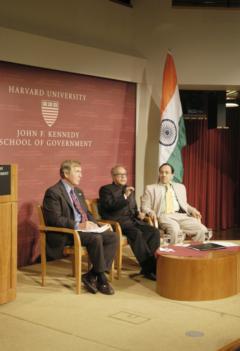
Sitting down to wait for my Defense Minister to arrive, I couldn’t help thinking how strange it was that I had to be in a faraway country to hear him speak. He walked in, diminutive but dapper, in a black Indian suit and the larger-than-expected crowd quietened down.

He began by admitting he was nervous, and it showed as he stumbled on a few words or phrases – the most memorable being ‘how things had changed since the “Cold year Wars”‘ – and fumbled a joke about George Bush. His delivery was oddly subdued, eyes firmly fixed to his sheaf of papers with few pauses to look up at his audience. His thick Bengali accent too was at times all-but-indecipherable: ‘India’s Look-East Policy’ becoming our “Locust Policy” and the meeting between Manmohan Singh and Musharraf taking place in Cuba’s capital of “Abana”.

Despite all this however, the speech itself was very good. In terms of content, it was certainly the best of the three I have heard so far from senior international political figures. There was little new for people familiar with India – he reiterated India’s secular commitment, the need to globally fight terrorism in the new security paradigm, India’s vital geo-political role in South Asia and the Indian Ocean, increasing ties with China and Japan, working through threats and issues from immediate neighbors etc etc. But for those unfamiliar with India, it was a crisp and concise overview of, in fact, the title of the speech “India’s Security Perspective.” A politician squarely addressing the topic? You don’t see that every day!

He was also excellent during the Q&A session, not shying away from tricky questions but answering them thoughtfully and directly, albeit with traces of diplomalese. When a Pakistani classmate asked him whether Kashmir would be solved in the student’s lifetime, Mukherjee smiled and said “I am optimistic it will be solved not just in your lifetime but in my lifetime.” He was superb on Iran: “they have the right to pursue their nuclear program but they must also submit to their obligations under the NPT; and any solution to the crisis must be peaceful and diplomatic.” He made a clear policy statement on Sri Lanka, given the repercussions Sri Lanka has for India, even though he risked offending several people in the audience: “any solution must respect the territorial integrity of Sri Lanka”. And he was clearly prepared for the question on India’s nuclear program and intentions, reading the flight of the question, dancing down the pitch and stroking it for a six that his compatriot Saurav Ganguly would have been proud of.

Off script, he became goofy again, ending with a toothy grandfatherly grin through which he thanked and wished his “young friends” good luck in their studies. But despite the stuttering start and awkward end, the middle was all substance. I left charmed and impressed.

Posted in Harvard Sixth Course | Leave a comment