Kissing the Tiger: Peace as a Pre-Requisite for Development

While creating Ashoka Peace, I co-wrote an article with my colleague Sarah Jefferson on Beyond Profit, which addressed something I deeply believe: that peace must come before, or at least hand-in-hand with development.

In this article, we discussed the stories of two classic social entrepreneurs – Jerry White and Neichute Duolo – who came up with new solutions for problems of violent conflict, and through those stories, we begin to elicit the principles and patterns that are driving innovation in the peacebuilding field.

You can also read the article in full on Beyond Profit.

—————————————-

Kissing the Tiger: Peace as a Pre-Requisite for Development

Roshan Paul and Sarah Jefferson

Jerry White was a 20-year-old college student when, on a camping trip in Israel, he stepped on a landmine and lost his left leg. A Massachusetts native, he spent the following year in Israel, learning not just how to walk again but also how to live as a survivor in society. Thirteen years later, he won the Nobel Peace Prize for his efforts in the International Campaign to Ban Landmines. But this was merely the beginning. Today, Jerry and his organization Survivor Corps are setting out on a more difficult journey: to build a world where there are no victims, only survivors.

Unlike Jerry, Neichute Doulo grew up in conflict-stricken Nagaland, a region in India comprising 17 different hill tribes. The area was never fully conquered by the British and its residents have carried that proud legacy into their battle against the state of India, one of the longest running secession movements in history. Convinced that Nagaland will not have a viable future (regardless of the outcome of the conflict) without indigenous small-scale industry, Neichute created Entrepreneurs Associates (EA) to foster a new generation of socially responsible business entrepreneurs that strengthen the Naga economy and allow youth the opportunity to actively contribute towards shaping a positive future.

Jerry and Neichute are classic social entrepreneurs, people who come up with new ideas to solve intractable social problems and work relentlessly to execute them in order to achieve lasting social impact; in this case, that of preparing society to overcome the effects of violent conflict. But why is building peaceful societies so critical for economic and social development?

No Development without Peace

Peace is a pre-requisite for development as a whole because it creates an enabling environment for the fundamentals of a society’s progress: human capital formation, infrastructure development, markets subject to the rule of law, and so on. In the absence of peace, education and health structures break down, systems to provide infrastructure disintegrate, and legal commerce is crippled. Critically, peace also frees up resources, both financial and human, that would otherwise be diverted to controlling (or creating) violence.

Intuitively, we’ve long known that peace and development go hand in hand – generally speaking, the more peaceful a society, the more prosperous and stable. But we’re only now starting to understand the economic costs of violent conflict. Over the last ten years, in about 60 countries, violence has significantly and directly reduced growth – in Brazil, 5% of GDP is lost due to violence and crime; in El Salvador it is 25%. The economist Paul Collier has shown that, on average, annual GDP growth of a conflict-affected country is reduced by 2.3% as a result of the conflict.

Moreover, there is a strong relationship between business enterprise and peace. In a 2008 worldwide study conducted by the United Nations Global Compact, 80% of senior managers felt the size of their markets grew with increasing peacefulness and 79% felt costs decreased with improving peacefulness. Yet, only 13% were aware of the metrics and tools that shed light on the peacefulness of the markets in which they operated. Businesses can play a central role in peace building, since they have an interest not just in profitability but the longer term stability of the markets in which they operate. Recognizing this, Daniel Suárez Zúñiga is developing a series of steps that the private sector in Colombia can follow in order to build peace. These include identifying ways to make business practices more transparent, resolving internal conflicts more constructively, and directing their attention to communities in ways more cognizant of social justice.

The Urgency of Now

Increasingly, peacebuilding is not just an economic necessity but a fiercely urgent one. Climate change, food and water scarcity, and the global economic crisis are all projected to exacerbate violent conflict in the years ahead as resources become scarcer, political instability rises, and inter-group tensions flare. For instance, a National Intelligence Assessment, prepared for American policymakers in 2008, predicted that the impacts of changing climate would emerge as a significant source of political instability over the next few decades, with water shortages in particular likely to create or exacerbate international tensions. Just this past July, there were community killings over water shortages in Bhopal, India when a family was falsely accused of stealing water from a pipe. Food shortages in Kenya and Nigeria are also of international concern, with Kenya especially on everyone’s watch list given its relatively recent tryst with election violence. Indeed, theUS National Academy of Sciences published fresh research in November 2009 indicating that, across Africa, violent conflict is 50% more likely in unusually warm years and is often connected to depleting food supplies. As these forces make themselves felt with ever-pressing urgency, it is critical that we learn how to live and work together peacefully to overcome these challenges to our planet.

The Social Entrepreneur’s Response

When facing a society in conflict, social entrepreneurs respond very much like they would to other social problems. They identify the root of the problem and look for the levers and jujitsu points that they need to press in order to change the nature of the system. As Jerry White got involved in the global anti-landmine campaign, he realized that the most important voice of all was missing from the debate: that of landmine survivors, the vast majority of whom are civilians. Through this crucial (and deceptively simple) insight – that the most authentic and compelling voices against destructive weapons are the civilians who are maimed and left bereft by them – Jerry introduced a new player in the global battle to rid the world of weapons such as landmines and cluster bombs. At the same time, he transformed previously disempowered victims into a powerful movement of survivors. Survivor Corps currently runs healing and rehabilitation programs in 59 countries and has successfully organized global movements to change international norms and laws regarding the use of such weapons.

Far away from the negotiating tables of the UN, Neichute Doulo, the first ever college graduate from his village in Nagaland, understood that one of the biggest drivers of the Naga conflict was that young people had few options to channel their energies towards something productive – Indian security forces did not allow groups of youth to simply hang out. Furthermore, the local economy was being taken over by immigrant businesses from other parts of India, which exacerbated Nagaland’s unemployment problem and increased the frustration and resentment felt towards the Indian state. On the other hand, Naga culture had well-developed social institutions – churches and village councils – that could play key roles in mentoring and fostering youth activity but were prone to look at business and commerce with a jaundiced eye. Believing that socially responsible businesses were the key lever to unlocking many of these problems, Neichute’s organization began to recruit a corps of Naga business leaders to pool their resources and goodwill towards helping youth entrepreneurs get off the ground, all the while mobilizing churches and village elders to play mentorship and cheerleading roles.

Today, there are 80 Ashoka Fellows like Jerry, Neichute, and Daniel working to prevent violent conflict. From their innovations, patterns and principles are emerging, insights that can point us towards the best solutions for resolving conflict in our world. Like Jerry White, many social entrepreneurs understand that those most affected by violent conflict are often the best people to lead us away from it. Like Neichute Doulo, others approach conflict from another angle altogether: creating a mutually beneficial environment outside the conflict that indirectly provides incentives to all to refrain from violence. A soon-to-be-published paper by Ryszard Praszkier and Andrzej Nowak in Columbia University’s Journal of Peace Psychology argues that this approach, which they call the employing of “positive attractors,” is often more successful than traditional negotiation and conflict resolution processes. In other words, peace becomes a collateral benefit, sneaking up on both parties before they know it.

There is still, of course, a place for traditional conflict resolution. Indeed, many social entrepreneurs are devising innovations in the manner in which conflicts are negotiated and resolved within or between societies. But if there’s one characteristic that distinguishes the social entrepreneur’s response from that of many leading political voices, it is that you don’t build peace by carving out your ideological territories. Rather, you engage the very people affected by the conflict, harnessing and redirecting energy towards a better alternative. It requires a shift in the way we often think about conflict, a shift that one social entrepreneur likens to “kissing a tiger.”

Only by being willing to “kiss the tiger” will we ultimately reverse the predicted escalation of global conflict, replacing it with an increasing number of peaceful societies well positioned for economic growth and social development and, by extension, social enterprise.
Posted in Social Change | Leave a comment

Social Entrepreneur Profile: Jerry White

Click here to read my profile on Ashoka Senior Fellow Jerry White, founder of Survivor Corps and Nobel Peace Prize laureate for his work with the International Campaign to Ban Landmines.


Posted in Entrepreneur Profiles | Leave a comment

Social Entrepreneur Profile: Gary Slutkin

Click here to read my profile on Ashoka Senior Fellow Gary Slutkin, founder of Ceasefire, one of the most successful violence prevention initiatives in the world.


Posted in Entrepreneur Profiles | Leave a comment

Social Entrepreneur Profile: Bill Pace

Click here to read my profile on Ashoka Senior Fellow Bill Pace, the driving force behind the creation of the International Criminal Court.


Posted in Entrepreneur Profiles | Leave a comment

Social Entrepreneur Profile: Dr. Devi Shetty

Click here to read my profile on Ashoka Senior Fellow Devi Shetty, world-famous heart surgeon, Mother Teresa’s personal physician, and driving force behind Narayana Hrudayalaya, the world’s largest heart hospital.


Posted in Entrepreneur Profiles | Leave a comment

Social Entrepreneur Profile: John Marks

Click here to read my profile on Ashoka Senior Fellow John Marks, founder of Search for Common Ground, the world’s largest peacebuilding NGO.

Posted in Entrepreneur Profiles | Leave a comment

Sixth Course, Session 13: John Howard

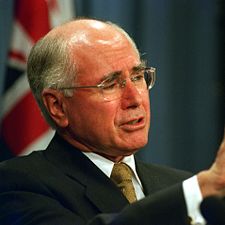
Australia has always had a hold on me, for reasons I still can’t fully name. And for nearly all my adult life, the man in charge of Australia has been John Howard. Even though I mostly disagree with his politics, I’ve always had a soft spot for Howard because he is a fellow cricket nut. That is why I was excited to be part of a small group of students that got to chat with the former Prime Minister for a couple of hours.

Howard’s childhood is a pointer to his personality and nature. His father was a gas station owner who fought in World War I. The household was conservative and politically conscious but largely adhered to a “hard-working small-business Protestant ethic”. Thus, it’s no surprise that the government he ran was “economically liberal and socially conservative – but liberal in the classical sense of free markets and little government intervention”. (The notion of conservatism in Australia is of course different from the United States. Howard was able to introduce gun control because Australians lack the “entitlement mentality when it comes to owning guns” that Americans possess. He claims that it was this policy that reduced the high homicide rates in Australia).

The conversation was wide-ranging but serious, dealing with the EU (Howard can’t fathom how nation states can give up soverignty to a larger entity), apologizing to the Aborigines (one generation cannot be held responsible for the sins of another), Fiji (“they seem to have fallen into a holding pattern of coups; the last one was even telegraphed in advance”), and Indonesia (needs to be commended for resisting “Islamic fascism”).

But I couldn’t resist introducing a lighter tone by asking about cricket. In some ways, just the fact that I get to ask a cricket question to Australia’s second-longest serving Prime Minister was in itself the enjoyment. “It is sometimes said”, I began, “that the second most important job in Australia, after the Prime Minister, is that of the captain of the Australian cricket team.”

“Nah, mate, that’s the most important job”, Howard barked back at me as the Australians chuckled and the Americans looked bewildered. “It’s certainly the most respected job”, inserted an Australian student; I’m not sure whether that was a pointed jibe at Howard or not, but the former PM grinned in response.

“I know you are a serious cricket fan”, I continued. “So, Mark Taylor or Steve Waugh, who was the better leader?” Now all the Australians cracked up for real. Howard paused for a moment and then chose the diplomatic route. “I can’t choose between them, they both had their strengths. Taylor had flashes of tactical brilliance. Waugh was tenacious and really grew in his job. I know them both and they’re very good men. I can’t separate them.”

The final question from the moderator was, of course, on what advice Howard had for the rest of us. He said three things: First, before you go into politics, do something else well. This will give you real world experience that is invaluable in the legislative process. Second, don’t succumb to the cynicism about public service. It’s the most rewarding thing you can do. And third, understand the debts you owe to the people who get you to where you are.”

Posted in Harvard Sixth Course | Leave a comment

Sixth Course, Session 12: Mikhail Gorbachev & Sakena Yacoobi

Late last Fall, we were graced by contrasting lectures in different parts of the school on the same night. One by a world famous Nobel Laureate credited with ending the Cold War and the other by a humble largely unknown woman working tirelessly for the rights of children and women in one of the hardest places in the world.

Funnily enough, it was the second lecture that was more moving and more inspiring.

My friend Ejaj Ahmad wrote the following email to me, and because he echoes everything I felt at these two events, I’m going to let him write this blog entry

———————————————-

First of all, like everyone else at Harvard Kennedy School (HKS), I, too, was very excited when I heard that the legendary former premier of Soviet Union, Mikhail Gorbachev, was coming here to give a talk at the forum. I initially didn’t win the lottery and had to work hard to secure a last-minute ticket to the event. I went there with high expections. After all, this is the man who brought the cold war to an end and played a critical role in shaping the history of the 20th century.

But to my disappointment, I found his narrative to be rather average with a few moments of eloquence here and there. Students at HKS attend these forums to draw inspiration from world leaders but I did not find his speech inspiring. He took us through the history of cold war era and provided useful insights into understanding the role of nuclear power then and its role in the world today. But where is the vision for tomorrow? Where is the fire? Perhaps he had the fire during the 1990s. Perhaps recyled stories and empty rhetoric of the cold war era don’t resonate with people from our generation. Or perhaps my understanding of Soviet history isn’t strong enough for a deeper appreciation of his legacy.

Photo credit: Ejaj Ahmad

I must confess, however, that he handled the questions very well. Here we saw more of the man behind the politician. Some of his stories were compelling and I was especially touched by his faith in the international legal framework to ensuring global order. He made two appropriate comments on terrorism and the role of US as a superpower. The first was in order to fight terrorism we need to address the root cause of terrorism which is poverty. Using military might against terrorism is only addressing the symptom and not the disease. His second comment was about the US not trying to dominate the world and expanding its military bases around the world. Rather, the US should maintain its leadership position by engaging other nations and creating a more participatory global political discourse.


In sharp contrast to the Gorbachev event, I was totally mesmerized by our other speaker of the evening. Dr Sakena Yacoobi is woman of character, upright and honest. She came to HKS to receive 2007 Gleitsman Leadership award. What I found most inspiring about her story was the tough choices she made in her life. She could have settled for the easy life in the US after her higher education but instead she chose the path less travelled and went to Afghanistan to give hope to poor women who had no one to give them hope.

But I want to emphasize something in the end. We all come to HKS to be future leaders and we attend these events to refine our own goals in life. I think I have learnt a powerful lesson from the two events tonight. There are two types of leaders in this world – leaders who are driven by their ego and leaders who are driven by their heart. While history bears testimony that both these types can be equally effective in leading change, I believe that leadership from the heart is the way forward for a fulfilling life. I don’t by any means intend to look down upon Gorbachev’s achievements but I personally could relate more to Dr. Yacoobi’s story. The passion in her eyes and the fire in her voice was truly inspiring. She spoke from her heart and that gave her a different kind of credibility. It is what professors here call ‘authentic leadership’. Sometimes it is easy for us to get caught up in this ‘great man’ theory and start thinking in terms of great deeds and great achievements.

We shouldn’t just focus on great things in life. We should try to find greatness in small things and small actions just like Dr. Yacoobi did. You know a hundred years from now perhaps people will not talk about Sakena but I know for sure that her talk tonight has definitely inspired a few young women in the audience to take up the challenge and start working on pressing issues relating to women in poor countries. She leads by example. She has changed more than 350,000 lives in Afghanistan and Pakistan in the last ten years. And she still has the flame alive. That to me is the story of a great woman.

Posted in Harvard Sixth Course | Leave a comment

Sixth Course, Session 11: P. Chidambaram

India’s current Finance Minister visited the Harvard Business School last week and delivered a boring recitation of India’s economic woes and a list of problems the country needs to fix in order to grow even further. There was much criticism of systems – especially the education system – and few ideas of how to actually make anything better apart from getting the Communists to stop hindering economic growth. Same old stuff. Perhaps the only redeeming feature of his speech was the deep, well-thrown voice in which it was delivered, which despite leaning towards the monotonous still possessed a rich timbre that held an audience’s attention.

He did redeem himself somewhat in the Q&A. When asked how to reconcile India’s energy problems with environmental control, he responded in the punchy way that is typical of what some people call “the New India”, aggressive, assertive, no longer willing to do as told for a few dollars of “aid”. Paraphrased in non-energy lingo, it roughly translates to: “Don’t expect us to be good when you’re going to be bad.” As the mostly Indian audience erupted in applause, what was lost is the question of whether this approach is the right policy or not.

Then came the almost obligatory question of how India is going to compete with China. Chidambaram replied in the same way that I’ve seen other Indian leaders reply: we’re not competing with China; India and China are two entirely different beasts. But then he added something new: “However, if there’s one thing I want us to learn from China, it’s the single-minded purpose and ruthless efficiency with which they get things done. If they promise to have a road built in 90 days, it’s ready in 75. We are nowhere close to this because of our politics and corruption. So we cannot compete with them on growth. However, there is the other side to democracy. I am more than willing to sacrifice a couple of percentage points of growth for the freedom to write and say and think just what I like.”

This, sadly, was the high point in a mostly disappointing hour and a half.

Posted in Harvard Sixth Course | Leave a comment

Sixth Course, Session 10: Mohammed Yunus

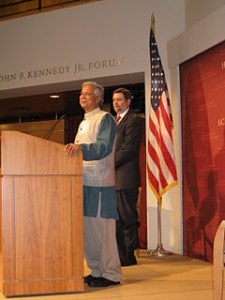
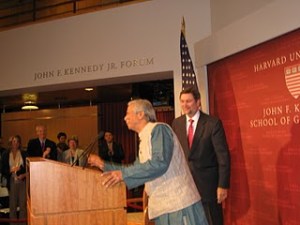
Often, superstar speakers can be frustrating because their high profile means they have to be carefully diplomatic, and hence they don’t say anything interesting. Even then though, it’s not what they say so much as how they say it that’s important, because it gives us an insight into how they think, which to me is perhaps the most important takeaway of all. But every now and then, a celebrity is not just candid but also lets us into the workings of a fascinating mind, and these lectures tend to be the best. Yesterday, Mohammed Yunus gave one of the best talks I’ve seen yet at the Kennedy School Forum.

“I never thought I’d be a banker”, he began. “I thought I would be a pilot or a captain or a policeman. So don’t worry about what you are going to do. Do it as it comes.” For those of us about to graduate and unsure what to do next, it’s nice to have a Nobel Prize winner tell you not to worry about it.

Photo credit: Ejaj Ahmad

What later became the Grameen Bank was initially a loan of $27 given to a few Bangladeshi women during a famine, where Yunus realized that teaching economic theory was meaningless when people are dying all around you. The success of this tiny loan eventually inspired the creation of the Grameen Bank. “People thought I was an angel for giving them this loan”, Yunus said. “So I thought, if I can be an angel for $27, I should do it a whole lot more.”

After nearly thirty years of micro lending, Yunus claims that five years of successful borrowing from Grameen can get you out of poverty. “Poverty is not created by the poor”, he stated. “It’s imposed upon them by the institutions we have created, the systems and concepts we decided should govern society. But because it’s an artificial imposition, it can be peeled off. That’s why 64% of people can move out of poverty with their own effort, if you can just give them a little credit to get started.”

One of the parties most guilty of this is the banking sector, because they make it so difficult for anyone to get credit, let alone the poor. “This sort of business is based on the theory that all everyone cares about is maximizing profit. So then they build a whole theory of our natures around this. So now everyone is busy fitting themselves to this theory, rather than have the theory fit us. But this is wrong because people are so much bigger than mere money-making machines.”

This idea is what led Yunus to the concept of “the social business”, where you recoup your investment but get no dividends after that apart from the satisfaction of helping people get out of poverty. Social business is so much better than charity dollars because no matter how well you use it, the charity dollar can only be spent once. But the social business dollar can be recycled endlessly to do good.

How exactly does the man widely known as the father of microfinance define the field he created, now that the field is evolving and spreading so many different ways? “I have a strict definition”, he says. “Microcredit is small loans to the poorest people, usually women, without collateral or guarantee, for income generating purposes, at a reasonable interest rate.”

When asked to compare Grameen Bank with some of the more profit-oriented approaches to microfinance, his answer was crisp and rather sharp. “The rate of interest should be the cost of the fund plus 10%. Upto 15% is ok but not ideal. Greater than 15% puts you in the territory of the moneylenders. And it is the moneylenders we have been fighting right through our existence.”

When asked about whether microfinance actually helps the poorest of the poor (one of the leading criticisms about microfinance currently being bandied about), he described how Grameen Bank gives loans of upto $15 to beggars. Naturally, climbing out of poverty is a much slower process for the poorest. “It takes time. When my colleagues get impatient with how long the beggars take to become more secure, I tell them to be patient. After all, they are simply in the process of closing down their begging division and strengthening their sales division. Restructuring always takes time!”, he ended with a smile that got the whole audience chuckling.

Photo credit: Ejaj Ahmad

He recounted an anecdote from the Nobel Prize ceremony to illustrate just how much the Bank is owned by the people. “When the Nobel committee told me that half the prize is going towards the bank, they asked me to bring one of the bank’s owners to the ceremony as well. I told them that the bank has 7.5 million owners. Now, given that Norway only has 4.5 million people, this presented a bit of a problem. But eventually, we brought one representative. To see one illiterate Bangladeshi woman give a Nobel Prize acceptance speech in front of kings and queens, televised globally…well, that’s just a beautiful thing.”

So it is. It’s also a beautiful thing to see someone use a combination of humility and a powerful vision to inspire an 800-strong crowd that has become jaded from watching a few too many uninspiring and dull heads of state.

Posted in Harvard Sixth Course | Leave a comment